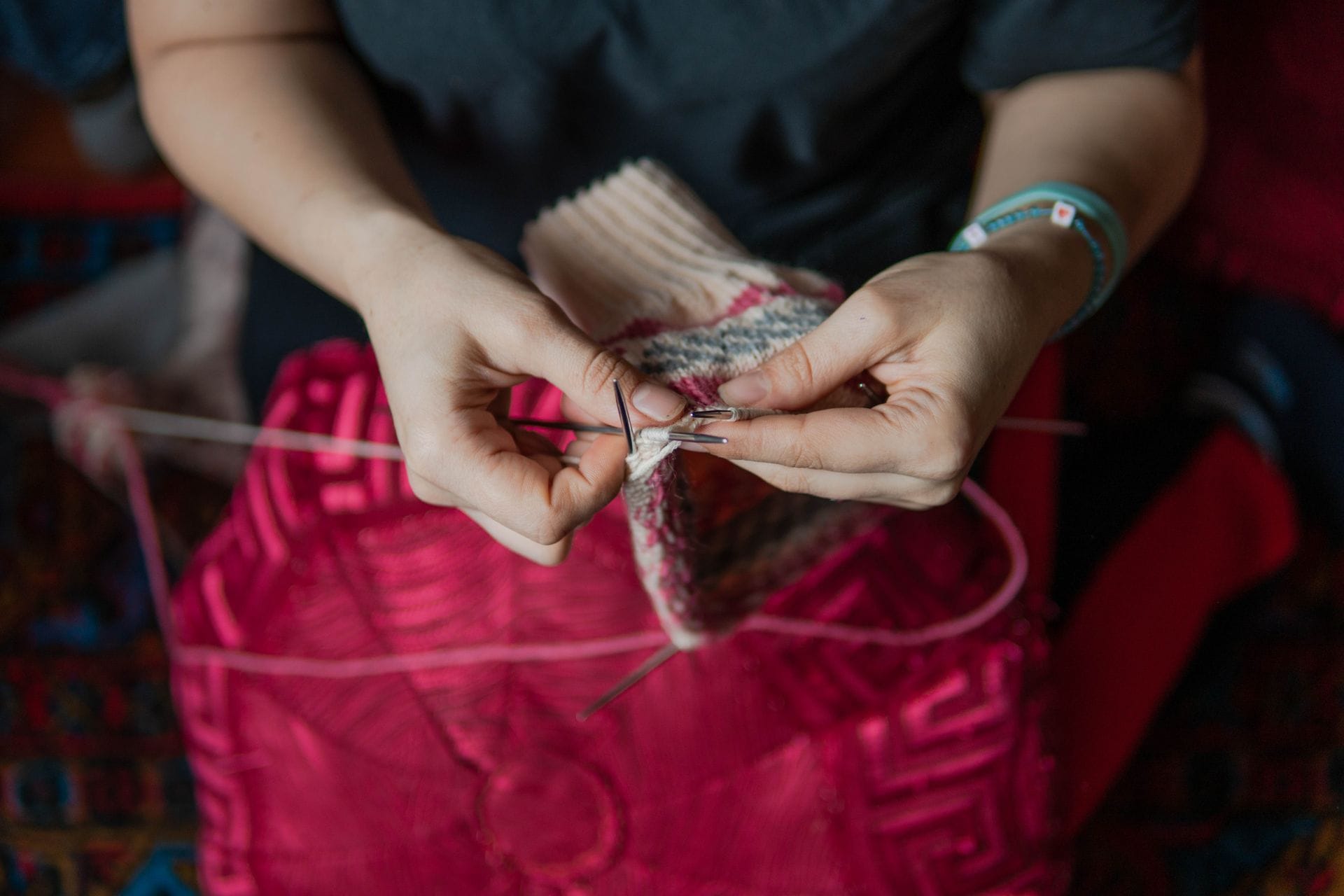

Portugal has sixteen native sheep breeds. Until a few years ago almost nobody was spinning their wool into yarn you could knit with. That has changed, mostly because of one shop in Lisbon. This is a guide to the sheep and the mills, and to the yarn we put in your hands on the Algarve retreat, with an honest note about which sheep it actually comes from.
Key takeaways
- Portuguese wool is rustic by American standards. Crisp on the needle. It blooms after washing and holds a stranded pattern flat. It is not merino-soft and does not try to be.
- Retrosaria Rosa Pomar in Lisbon processed more than twenty tons of native Portuguese wool in 2025 and works with seven of the sixteen breeds.
- Mondim, the yarn we knit with in the Algarve, is a fingering-weight 3-ply spun mostly from Campaniça sheep of the Alentejo. Beiroa, from the same shop, is spun from Serra da Estrela sheep.
- Burel, the felted mountain cloth, is still made in Manteigas. Two factories, both of which you can walk through.
Which sheep are we talking about
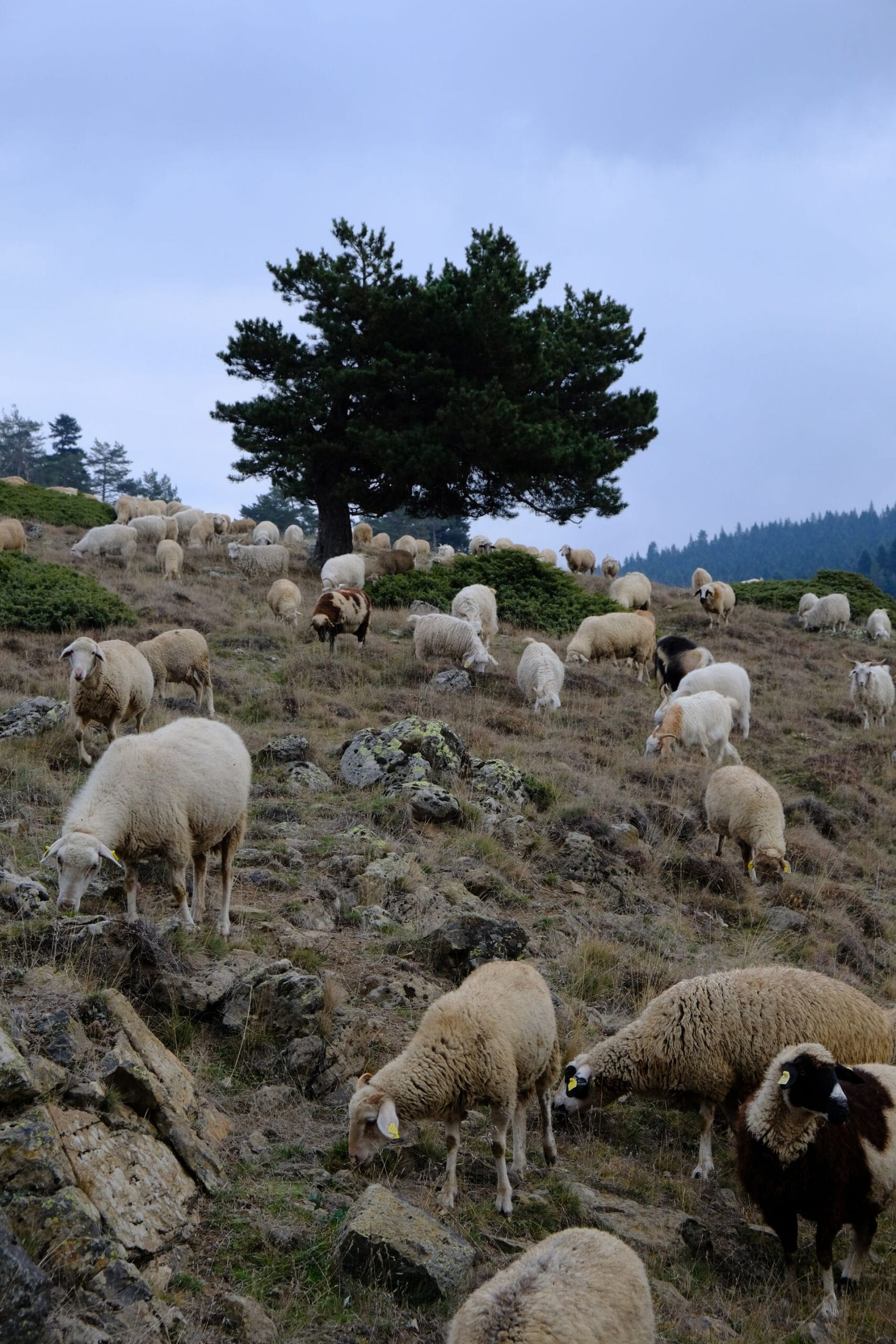
Portugal’s breeds fall into three families. The family tells you what the wool wants to be. Merinos, in the south, give a fine, short, crimpy fleece. Churras, in the north and the far south, give a long coarse fleece with pointed locks. That was the wool that got stuffed into mattresses and woven into rugs. Bordaleiros sit in between: longer and thicker than merino, thinner and shorter than churra, with a large, defined crimp. Most Portuguese knitting yarn comes off that middle family.
A few breeds worth knowing by name. The Bordaleira Serra da Estrela is the mountain sheep of central Portugal, horned in both sexes, mostly white with a black minority. There were 288,000 of them in 1986. In 2024 there were about 45,000 to 50,000, in 268 flocks. They are kept for milk now, and the milk becomes Queijo Serra da Estrela, the cardoon-set cheese with market records going back to 1287.
The Churra Mondegueira comes from the same mountains. It is the country’s only double-coated breed and it is down to a little over two thousand ewes. The Merino da Beira Baixa, around Castelo Branco, gives fine wool in the country’s east. The Saloia grazes the hills around Lisbon. In the nineteenth century its wool was praised as among the finest in Portugal. There are a couple of thousand animals left, and Retrosaria buys the breed’s entire annual clip. Then the Campaniça, an Alentejo breed. Most of Mondim is spun from it.
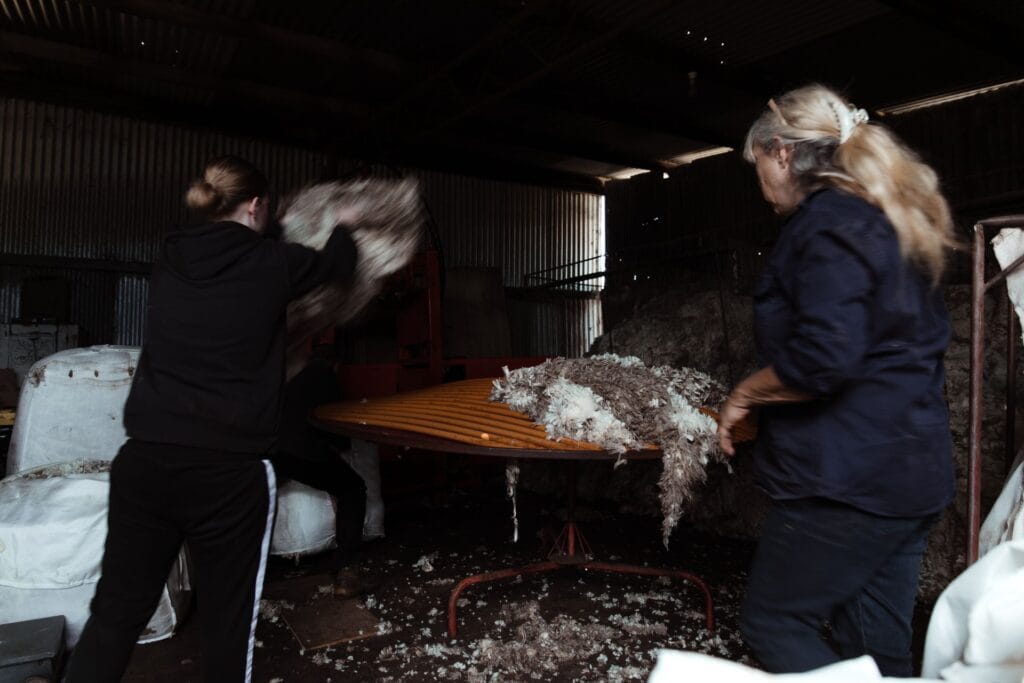
What almost all of these have in common is that the wool was, for decades, worth nothing. Farmers sheared because they had to. In many places the fleece was worth less than the shearing. The cheese paid. The lamb paid. The wool went to the mattress trade or nowhere.
Retrosaria Rosa Pomar and the yarn we knit with
Rosa Pomar studied history and visual arts in Lisbon. She also wrote the book on Portuguese knitting traditions, Malhas Portuguesas. Retrosaria opened as a website in 2008 and as a shop in 2009, and it now sits at Rua Maria Andrade 50A, near Intendente metro, open Tuesday to Saturday from ten to seven. Here is what makes it different from every other yarn shop you have been in. The yarns on the shelves are its own, spun from the breeds above, one breed or blend per yarn, with the sheep named on the label.
Mondim is the one we use in the Algarve. Fingering weight, 3-ply, worsted-spun, no nylon and no superwash. 100 grams and 385 meters to the skein. EUR 10.25 in Lisbon, around USD 16 in the United States. Most batches come from Campaniça sheep. The name is borrowed from Mondim, a village once known for its sock-knitting cottage industry.
There are more than forty colors. Four are undyed naturals. The variegated shades get dyed by hand in small lots that vary. On Ravelry it carries a 4.8 rating from nearly two thousand knitters and close to fourteen thousand projects. One UK shop calls it a “high-quality affordable workhorse” that “knits nicely, blooms beautifully” and gives “a solid fabric without being too heavy.” That is why Maaike chose it for stranded colorwork. The stitches sit flat. The floats behave. After a wash the fabric fills in and softens.
It is not merino. If you knit only with soft, slippery yarns, Mondim will feel crisp on the needles for the first hour. Most people stop noticing by the second. Knit a swatch. Wash it. Set it next to the unwashed skein.
A skein with the breed on the label is a skein you can trace back to a hillside. Most yarn cannot say that.
If you want the Serra da Estrela sheep specifically, the yarn is Beiroa. 100 percent Bordaleira Serra da Estrela from free-grazing flocks, a DK-weight single, 100 grams and 230 meters, EUR 9.10, in more than thirty colors including undyed. Knitters say it softens and blooms after a wash. That is the mountain wool doing what it has always done.
Other yarns in the range name their sheep the same way. João is Alentejo merino. Brusca is half Saloia and half merino. Pegulhal is a fingering blend of Campaniça and black merino, made for stranded knitting. Badana blends the critically endangered Churra Badana with Serra da Estrela and Campaniça. Bucos is Bordaleira from the Minho, spun by hand on a spindle.
How does Portuguese wool compare to Shetland and Lopi
Knitters who love stranded colorwork usually arrive at Portuguese wool from one of two directions. The comparison helps.
Jamieson and Smith 2-ply jumper weight is the Shetland standard. Woolen-spun, sold in 25-gram balls of about 105 meters, roughly USD 6.95 a ball or USD 28 per 100 grams. It is crisp off the needle and softens with washing and wearing. The surface is slightly hairy, so it grips itself and the floats stay put.
Mondim is worsted-spun and plied. Smoother, a touch denser in the hand, less halo, more stitch definition, at about USD 16 per 100 grams. Both hold a Fair Isle pattern flat. Shetland forgives a loose float slightly more. Mondim shows a crisp motif slightly better.
Léttlopi is a different animal. An aran-weight Icelandic single, 50 grams and 100 meters, USD 7.75 a ball, hard-wearing and airy with a strong halo. It knits a yoke sweater in a weekend. It is also not a fingering yarn. If you want Lopi’s rustic character at a finer gauge, Beiroa at DK is the closer Portuguese cousin.
None of these has published fiber diameter figures that would let us give you a micron comparison. We will not invent one. Knit the swatches.
Burel and the mills still working
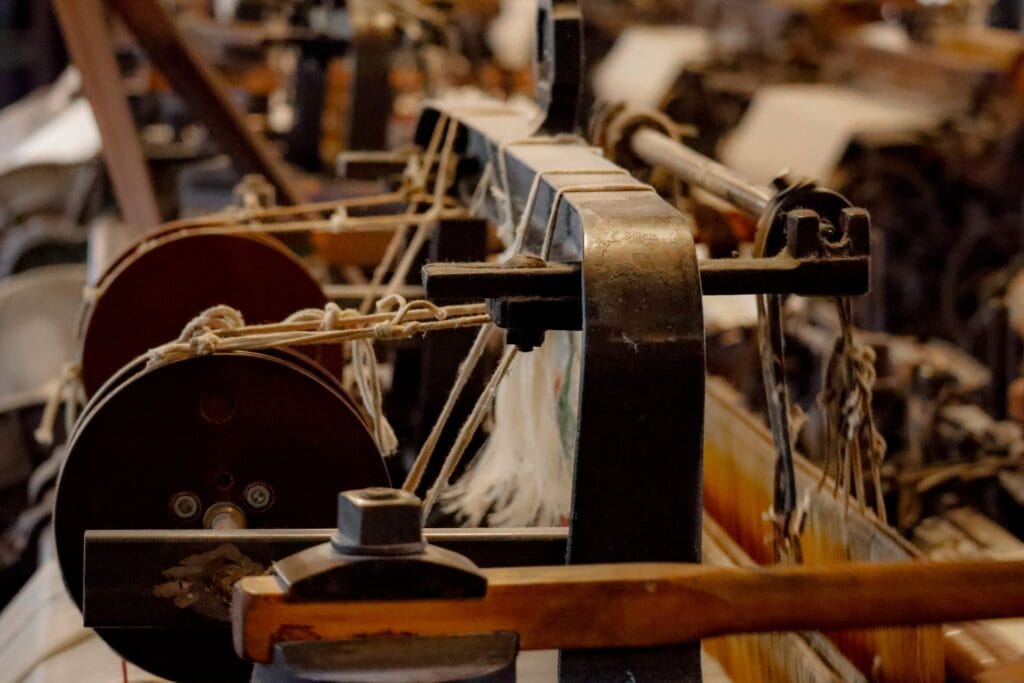
Burel is the wool cloth of the Serra da Estrela. It is woven, then fulled: beaten and scalded in hot water until the weave closes. What comes out is dense, tough and close to waterproof. Shepherds wore it as capes for centuries.
For a while in the twentieth century Manteigas and Covilhã lived on it. A hundred or more factories in the region. Covilhã called itself the Portuguese Manchester. Most of that closed from the 1950s onward. Two factories in Manteigas kept going, and both take visitors.
Ecolã sits at Amieiros Verdes in Manteigas. The Clara family has run it since 1925, and it calls itself the oldest blanket factory in the country. Joana Clara and her father João run it now. Visits are Monday to Friday nine to four thirty and Saturday mornings, around EUR 5. There are shops in Lisbon and Porto. The factory still works with natural fleece colors: white, brown and the honey shade they call surrobeca.
Burel Factory is a few doors along, in the old Lanifícios Império, founded in 1947. It went under, and was rescued in the early 2010s by the couple who built the Casa das Penhas Douradas hotel up the mountain. Guided tours run Monday to Saturday at eleven and four. EUR 5, booking required. The shop is open nine to six. They weave on the old looms. These days they design for architects and fashion as much as for shepherds, with shops in Lisbon and Porto.
Down the mountain in Covilhã, the Museu de Lanifícios of the University of Beira Interior occupies the Real Fábrica de Panos. That is the royal cloth factory founded in 1764, and the dye works are still in place. Tuesday to Saturday, ten to one and half past two to six. An hour in the dye house explains Portuguese wool faster than any article does, this one included.
Where to buy Portuguese wool from the United States
Retrosaria ships worldwide from Lisbon. Registered mail to the US runs from about EUR 9 for a single skein to EUR 35 for two kilos, and orders above that get split. Customs is your side.
Several US shops now stock the range. The Woolly Thistle carries Mondim at USD 16.95, along with Pegulhal, Vovó, Brusca and Mungo. Mother Knitter in New Jersey and Knitapestry in New Jersey both list Mondim at USD 16. Ask your local shop. The list is growing.
The better answer is to buy it in Lisbon. The Algarve retreat’s group transfer leaves from Lisbon, and Retrosaria is a fifteen-minute taxi from the airport. Arrive a day early. Bring a bag with room in it.
Why we knit Portuguese wool on the Algarve retreat
Because a retreat about place should use the wool of the place. Our Colorwork Knitting Retreat in the Algarve runs at Hortas do Rio in Carrapateira, on Portugal’s west coast, in two weeks in May and June 2027. Maaike van Geijn teaches stranded colorwork every morning. The yarn kit is Mondim, in shades taken off that coastline: the schist of the cliffs, the dune grass, the cistus, the Atlantic at nine in the evening. You knit a landscape in the wool of the country you are looking at, and the rest of the kit goes home with you. Bring 2.75 mm needles. Everything else is on the table.
For where else in Portugal wool and cloth are still made, and how to get to the mills, see Portugal for Makers. For the coast the retreat sits on, see the Carrapateira guide.