
Colorwork knitting covers every method of putting more than one color into a knitted fabric, and the names people use for it are famously muddled. Fair Isle gets applied to any sweater with a patterned yoke, intarsia gets confused with stranded knitting, and knitters who want to try one of them often don’t know which they are looking at. This guide sorts out the terms, traces where the traditions came from, and walks through the technique in enough detail that you can cast on a first project with the right expectations.
Key takeaways
- Stranded knitting carries two or more colors along each round, with the unused yarn floating across the back. Fair Isle is a specific Shetland form of it, traditionally with two colors per row in Shetland wool.
- Intarsia works separate blocks of color with separate balls or bobbins, usually flat, and carries nothing across the back.
- The story that Fair Isle patterns came from shipwrecked Spanish Armada sailors in 1588 is a legend. The earliest patterned knitting found in Shetland dates to around 1700, and surviving garments to the 1850s.
- Value contrast (how light or dark each shade is) decides whether a pattern reads clearly far more than the choice of hue does.
Three techniques that often get confused
Kelbourne Woolens, a yarn company in Baltimore, gives the clearest hierarchy we have found. Colorwork is the umbrella term for any knitting with multiple colors in a single row or round. Stranded knitting is the branch in which you work two colors (occasionally more) across the same round, knitting with one while the other travels along the back of the fabric as a loose strand called a float. Fair Isle sits inside that branch as the tradition of one small island between mainland Shetland and Orkney, and Kelbourne puts it plainly when it says that calling all stranded knitting Fair Isle is inaccurate.
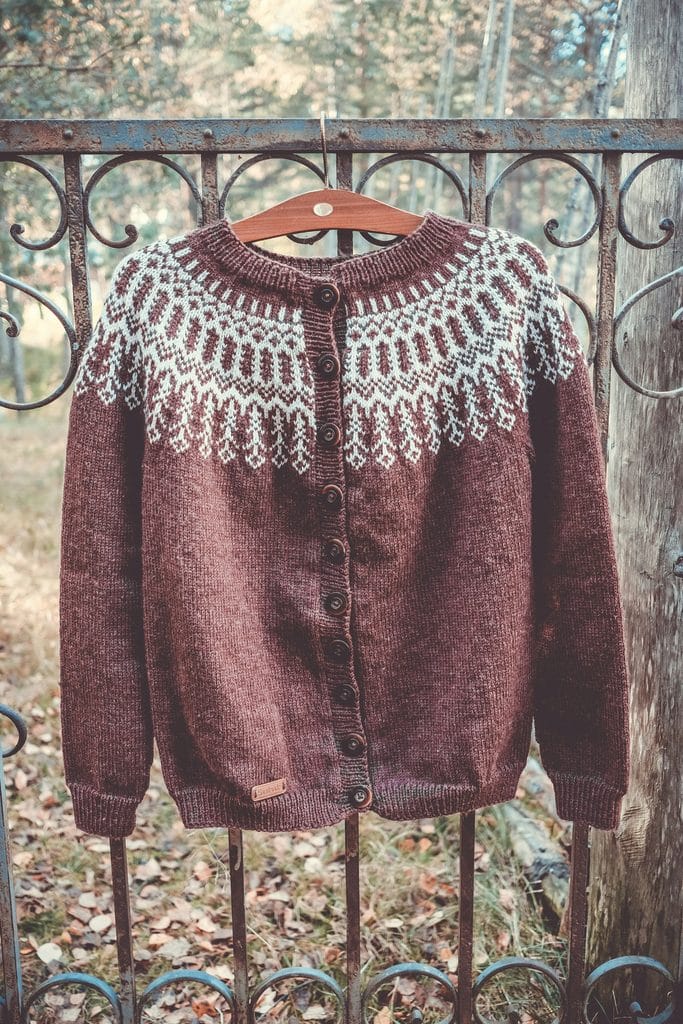
The strict definition matters to the people who still knit it. The UK’s Heritage Crafts association, which lists Fair Isle knitting on its Red List of Endangered Crafts, describes it as knitted in 100 percent Shetland wool with no more than two colors in any one row. The Shetland knitter Hazel Tindall, twice crowned the world’s fastest knitter, writes that three colors in a row are rare. The motifs are small and geometric, built around OXO bands and the narrow borders Shetlanders call peeries. Traditional jumpers were knitted in the round up to the armpits, and the sleeves were joined afterward.
Intarsia works on a different principle. Each area of color gets its own ball or bobbin, the blocks fit together like pieces of a jigsaw, and no yarn crosses the back. You knit it flat, back and forth, and at every color change you twist the old yarn around the new one so the two areas don’t separate into a hole. Intarsia suits large shapes such as a single motif on a sweater front, an argyle diamond or a picture, which would leave impossibly long floats in stranded work.
Two cousins are worth knowing by name. Mosaic knitting, which the American knitter Barbara G. Walker named and set out in her 1976 book Mosaic Knitting, uses only one color per row and creates the pattern by slipping stitches from the row below. Double knitting produces two layers at once, with the pattern reversed on the back, and makes a fabric that has no wrong side. Both give a colorwork effect while you handle only one yarn at a time, which is why some teachers start beginners there.
Where colorwork knitting comes from
Almost every history of Fair Isle knitting repeats the same story. In September 1588 El Gran Grifón, a supply ship of the Spanish Armada, wrecked at Stroms Hellier on Fair Isle, and the surviving crew spent about two months on the island. The legend holds that the islanders copied their patterns from the sailors’ clothing. The textile historian Deborah Pulliam, in a paper for the Textile Society of America, found no evidence of a multicolored knitting tradition in sixteenth-century Spain, and pointed instead to patterned mittens and socks excavated in the Baltic, around Riga. The University of Glasgow’s Fleece to Fashion project calls the Armada story romanticized and debunked, and the V&A notes that the design influences more plausibly came from Scandinavia.
The physical evidence is later. In 1951 peat cutters at Gunnister, in the north of Shetland, found the body of a man buried around 1700, dated by coins minted in the 1680s. Among his belongings was a knitted purse patterned in red and white, which the Shetland Museum and Archives describes as the earliest physical example of Fair Isle-type knitting in Shetland. The original is in the National Museum of Scotland in Edinburgh. The earliest surviving Fair Isle garments are caps from the 1850s and 1860s, held in Edinburgh and in Lerwick.
What made the style commercial was the islands’ position on the shipping routes. From around 1760 Fair Isle families traded knitwear with passing ships, and by the late nineteenth century the island shop was importing madder for red and, by 1891, ready-spun yarn. Madder and indigo gave the reds and blues, set against the undyed natural shades of Shetland sheep. The Scottish National Antarctic Expedition of 1902 to 1904 ordered around a hundred sweaters.
Fashion followed in the early 1920s, when the Prince of Wales, later Edward VIII, wore a Fair Isle sweater to play golf at St Andrews. The V&A credits him with starting a craze for knitted jumpers, although Glasgow’s researchers point out that the style was already fashionable before he took it up. The museum holds a 1931 jumper by Tulloch of Shetland, gray ground with blue, yellow, red, green, brown and black patterning, worked in only two colors per row. Chanel and Jean Patou made their own versions in the 1930s. The relationship with luxury fashion has not always been easy. In 2015 Chanel apologized to Mati Ventrillon, a designer living on Fair Isle, after showing pieces closely based on her work, and agreed to credit her. Heritage Crafts now counts only four professional knitters on the island, and genuine pieces carry the island’s star motif trademark.
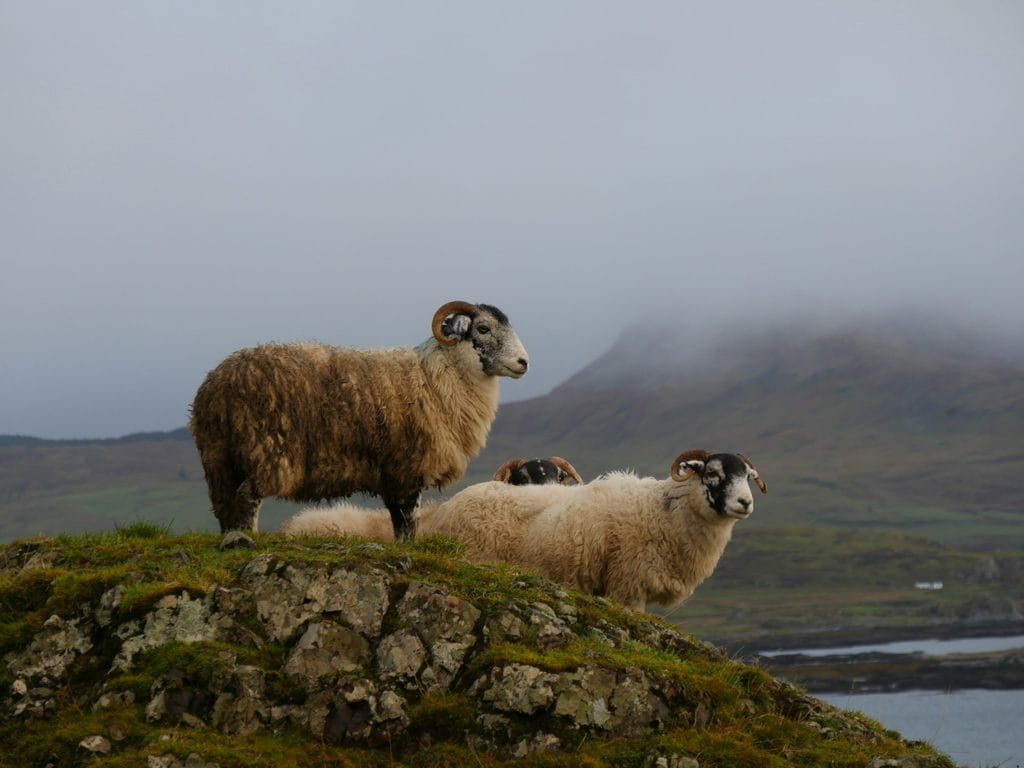
Other northern traditions grew up separately. In Selbu, in central Norway, a young woman named Marit Emstad wore black-and-white patterned mittens to church around 1857 that the valley later turned into a product. She organized commercial production in the 1890s and sold the first pair to Trondheim Husflid in 1897. By the 1930s and 1940s about three thousand knitters in the district depended on it for their main income. In Sweden, Emma Jacobsson founded Bohus Stickning in 1939 to give paid home work to women in the quarry districts of Bohuslän, and its angora-blend yokes, which often used three or more colors in a round, sold in the United States through the 1950s before the company closed in 1969. The Icelandic lopapeysa, with its circular yoke, is younger than most visitors assume. It appeared in the 1950s, and knitting historians still disagree about who designed the first one.
Intarsia has a separate lineage. Argyle, the diamond pattern most people picture when they hear the word, derives from the tartan of Clan Campbell of Argyll and from Highland hose, and it is generally knitted as intarsia. Pringle of Scotland, founded in Hawick in 1815, turned it into a fashion staple after hiring Otto Weisz in 1934 as the knitwear industry’s first full-time designer. Kaffe Fassett later pushed intarsia toward painting, and in 1988 he became the first living textile artist given a one-person show at the V&A.
Portugal and the Andes add a thread that is easy to overlook. Portuguese-style knitting runs the working yarn around the back of the neck or through a pin at the shoulder, and PieceWork notes that it widens the options for stranded work, since the knitter can manage two strands with little hand movement. Rosa Pomar, whose book Malhas Portuguesas (published in English as Portuguese Knitting) traces the craft in Portugal from the Middle Ages, covers the tools and techniques of mainland Portugal, the Azores and Madeira. In the Peruvian Andes, knitters on Taquile Island in Lake Titicaca, whose textile art UNESCO inscribed on its intangible heritage list in 2008, work finely patterned chullo hats on five thin needles with the yarn around the neck. We found no Portuguese stranded tradition comparable to Shetland’s, but the way many Portuguese knitters hold their yarn suits the technique well.
Holding two yarns at once
There is no single correct way to manage two colors, and Brooklyn Tweed describes the choice as a matter of anatomy as much as dexterity. The main options are these.
- Drop and pick. You hold one color at a time, drop it when the chart changes and pick up the other. It is slow, but it needs no new skill, and many knitters use it for their first hat.
- Two-handed. One color sits in the right hand and is thrown English-style, the other sits in the left and is picked Continental-style. Tin Can Knits teaches it alongside drop and pick.
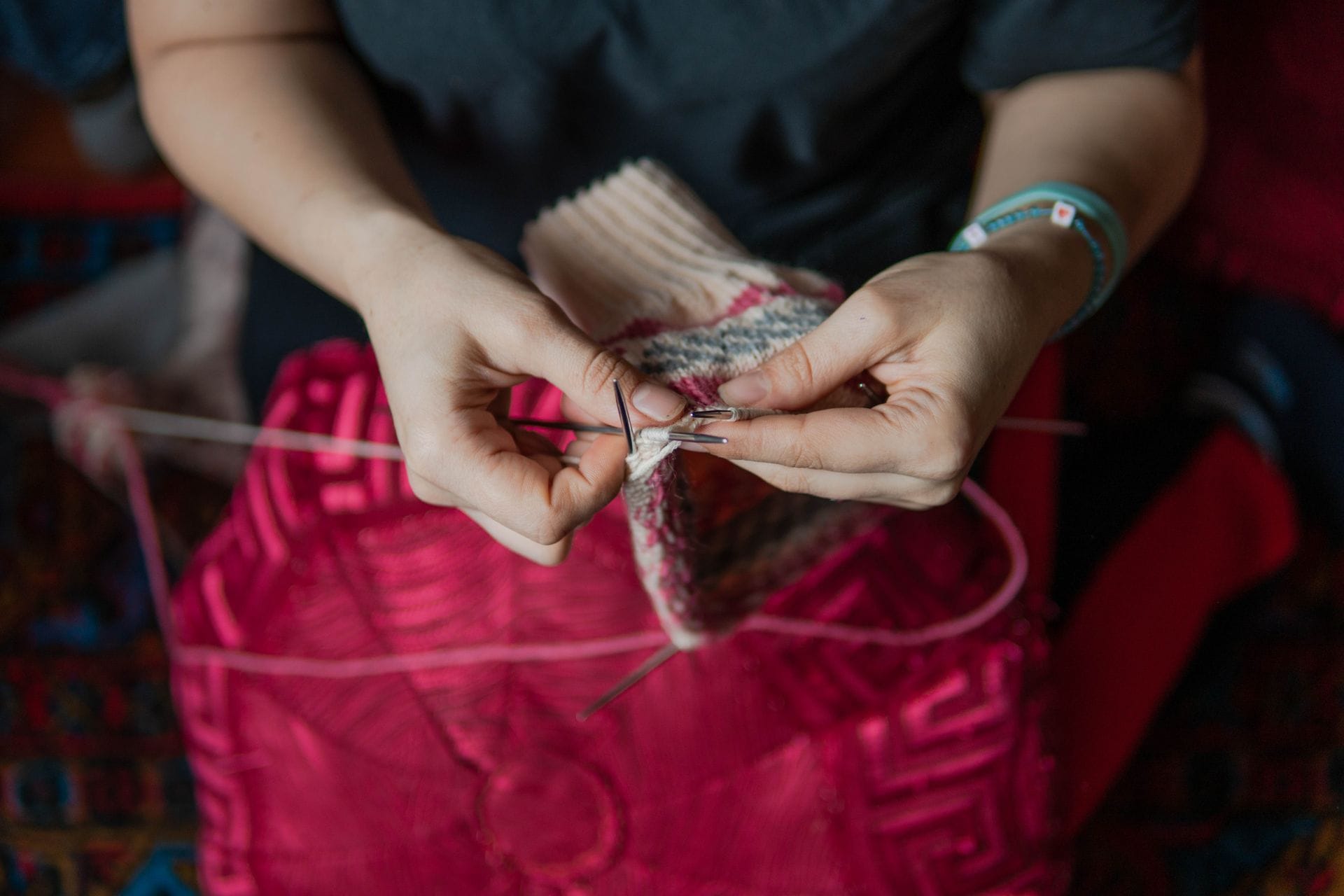
- Both in one hand. You hold both strands over the left index finger, one nearer the tip, or over two fingers of the right hand. Knitting thimbles and ring guides with two channels keep the strands apart.
- Around the neck. The Portuguese and Andean method described above, which frees both hands to manipulate the needles.
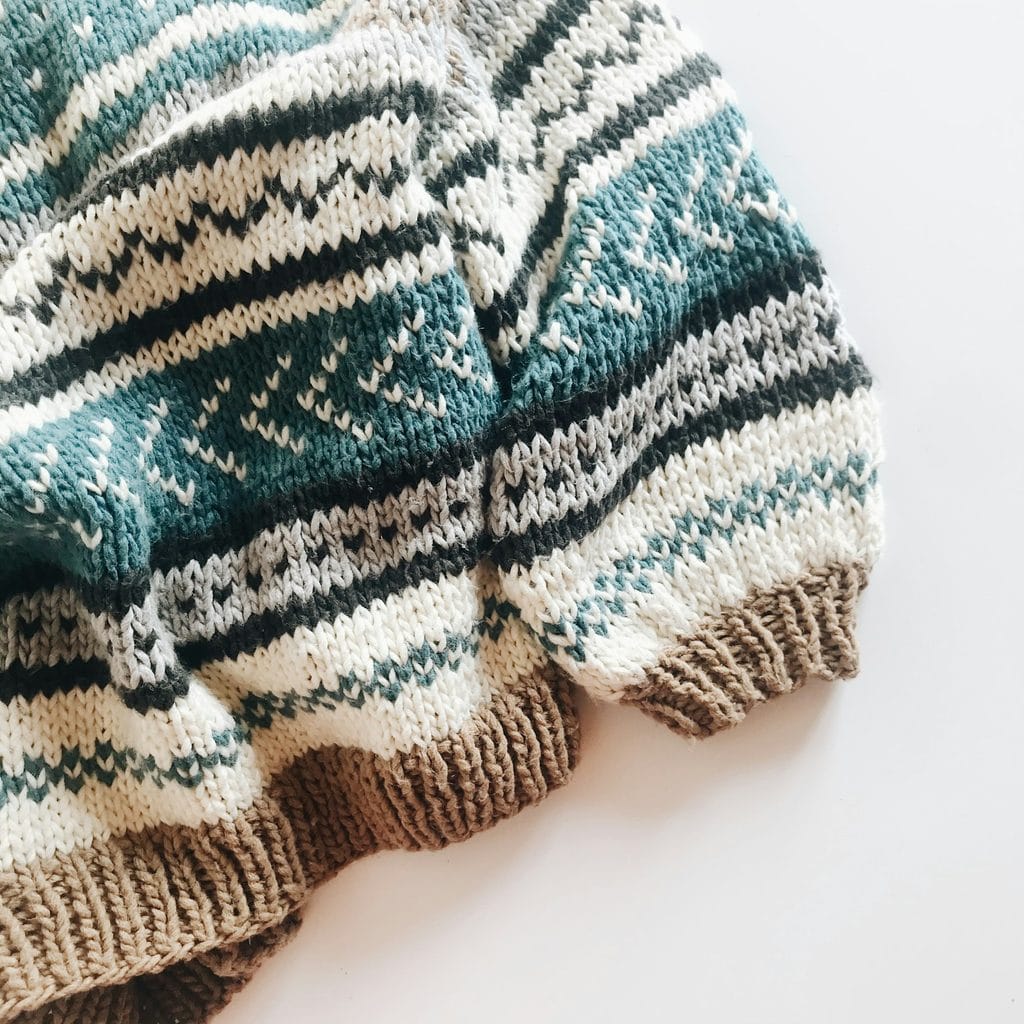
Whichever you choose, keep each color in the same position for the whole project. The yarn carried below the other, which is the one in the left hand in two-handed knitting, travels a slightly longer path and produces a slightly larger stitch, so it stands out more on the front. Kate Atherley, writing for Modern Daily Knitting, puts the rule as consistency above everything, and Brooklyn Tweed advises carrying the pattern color below the background so the motif is the part that pops. If you switch positions halfway up a yoke, the change shows as a band where the motif suddenly looks thinner.
Tension, floats and the mistakes that show on the front
Nearly every problem in a first stranded project comes from floats pulled too tight. A tight float gathers the fabric behind it, and the front puckers into ridges that blocking cannot fully relax. The fix is mechanical. Before you knit with the new color, spread the stitches already on the right needle to their full width, so the strand you carry across the back spans the same distance the fabric will when it is worn. Stranded fabric also has less stretch than plain stockinette, which matters when you choose a size.
Long floats snag fingers and buttons, so knitters catch them against the working yarn every so often. The designer Sandi Rosner, writing for Interweave, tacks any float longer than five stitches, or about an inch, and shortens that to half an inch for baby clothes. Not everyone agrees. The designers behind Tin Can Knits say they almost never trap floats in sweaters, though they do in mittens, where fingers catch on the inside. Traditional Fair Isle patterns keep the floats short by design, which is one reason the small repeats survived.
A few other faults recur. A jog appears where each round begins, because knitting in the round is a spiral, and most knitters accept it at the side seam or use one of the published jogless techniques. The two strands twist around each other as you work, and keeping each ball in its own bowl on either side of your chair makes the twist easy to undo. Stranded fabric also tends to knit to a tighter gauge than stockinette in the same yarn, so swatch in pattern, in the round.
Then there is the steek, the column of extra stitches that lets you knit a cardigan or armhole in the round and cut it open afterward. Kate Davies, a designer who works in Scotland, traces the word to Middle English steken, to shut or fasten, and notes that in Shetland and Scots to steek meant to sew or knit. Modern knitting has turned the meaning around. Knitters secure the edges with crochet or a line of machine stitching before cutting, and sticky, woolen-spun Shetland yarn felts slightly at the cut edge, which is why some knitters of Shetland wool skip the reinforcement entirely. Knitting unravels along the rows, and a steek is cut up the columns, which is why a secured cut holds better than most people expect.
Reading a colorwork chart, with a worked example
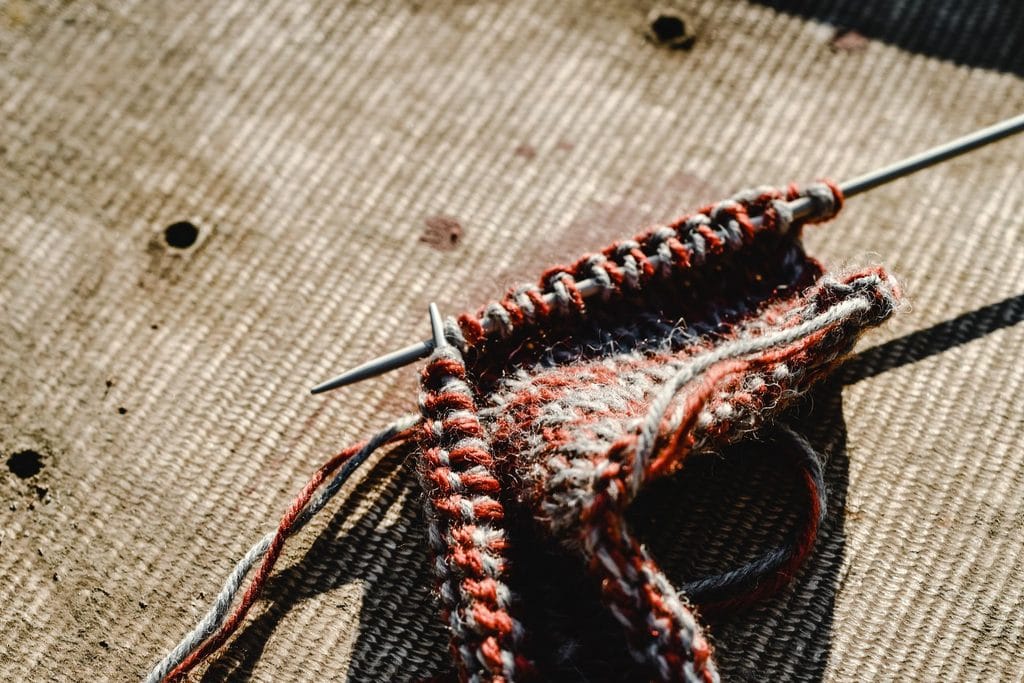
A colorwork chart is a grid in which each square is one stitch and its color is the yarn you knit it in. When you knit in the round you read every row from right to left, starting at the bottom, because every round is worked on the right side. Flat knitting alternates, right to left on right-side rows and left to right on wrong-side rows, which is one reason most stranded knitting happens in the round.
Take a small peerie repeat, four stitches wide and four rounds tall, in a light background and a dark pattern color. Knitted in order, it reads like this.
- Round 1. One dark, three light, repeated around.
- Round 2. Dark, light, dark, light, repeated around.
- Round 3. One dark, three light, as in round 1.
- Round 4. All light.
Knitted over a multiple of four stitches, those rounds produce a band of tiny diamonds. The longest float is three stitches, so nothing needs catching, and the plain fourth round gives your hands a rest before the next band. Most Fair Isle patterns work the same way, with a short border like this one separating wider OXO bands, and a knitter who has mastered a four-stitch repeat can read any chart in a pattern book.
Choosing colors that read as pattern
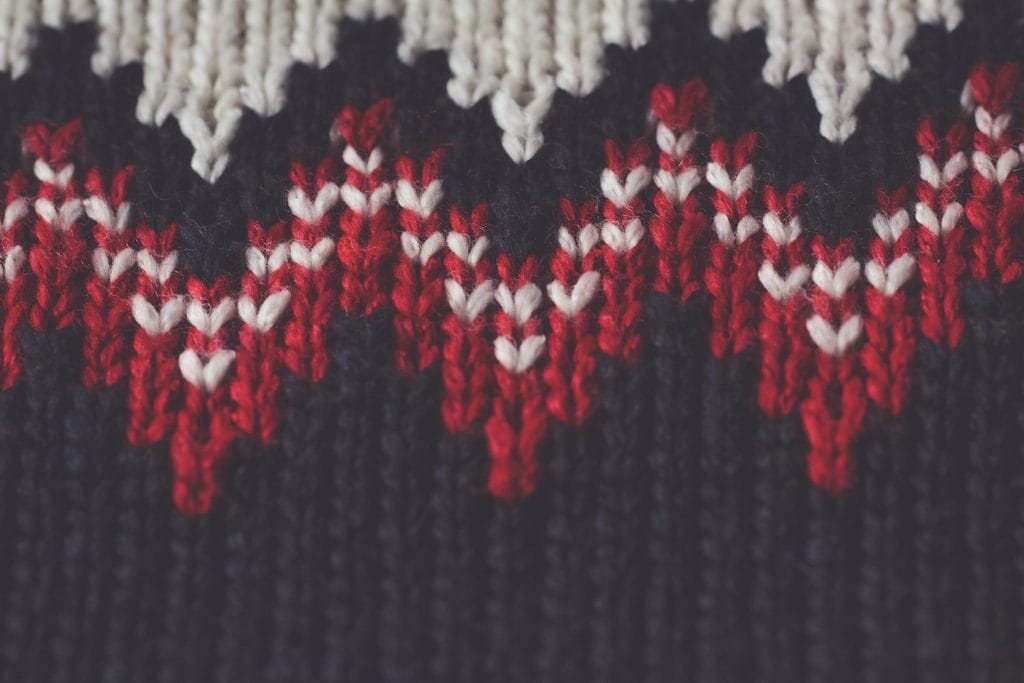
A motif is visible only if the two yarns differ in value, meaning lightness or darkness, and hue has far less to do with it. Brooklyn Tweed warns that without varied value the result is a muddy motif, and suggests squinting at the yarn or photographing it in black and white on a phone. A red and a green of the same value, which look lively side by side in the skein, turn into the same gray in the photograph and into a blur in the knitting.
Fair Isle knitters handle value with a technique that looks complicated and is simple to plan. Claire Morson, writing for The Knitting Guild Association, shades both the background and the pattern through a sequence running light to dark, and keeps the darkest background shade clear of the lightest pattern shade. The eye reads a gradient in each and the motif stays sharp across the whole band. A small quantity of a brighter shade in the center of a band draws the eye without adding clutter. Wrap the yarns around a strip of card before you commit, or knit a quick swatch in the round.
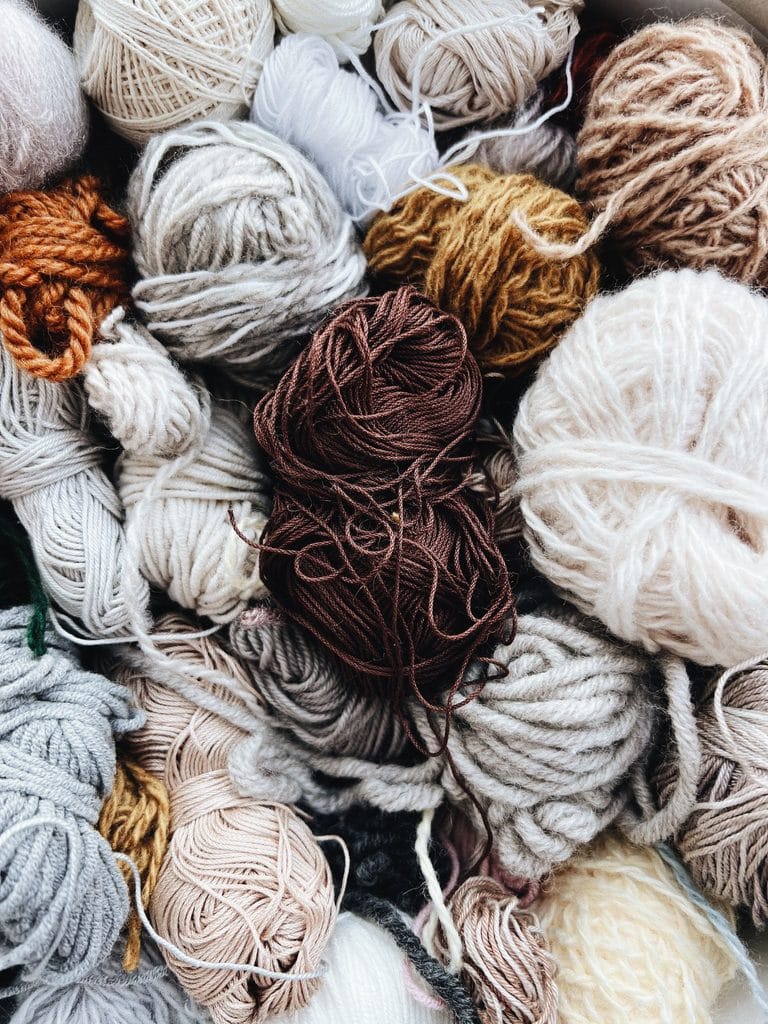
The yarn affects the colors too. Woolen-spun Shetland wool such as Jamieson & Smith’s 2ply Jumper Weight, currently in about a hundred shades, has a slight halo, and after blocking the fibers bloom and the colors soften into each other. A smooth worsted-spun yarn, such as the Portuguese Mondim we use on our retreat, keeps each stitch crisp and the motif sharp. Our piece on Portuguese wool compares the two in more detail.
Projects to learn on first
A hat is the standard first project, because it is small, knitted in the round and forgiving of uneven tension once it is blocked. Tin Can Knits’ Clayoquot Toque is free, uses DK yarn in three colors and comes in sizes for newborns through adults, which makes the first attempt quick. Kate Davies’ Peerie Flooers, a paid pattern in fingering weight with corrugated rib and a band of small flowers, is the natural second hat, finer and closer to the Shetland tradition.
After a hat or two, a yoke sweater teaches you to manage a pattern across decreasing stitch counts. Tin Can Knits’ Strange Brew is a paid recipe in 25 sizes that lets you design your own yoke. Socks come next for many knitters, because the stitch count is small but the fit leaves no room for tight floats. That is the project on our Colorwork Knitting Retreat in the Algarve, where Maaike van Geijn teaches an all-over stranded sock she designed from the colors of the Carrapateira coast, in three or four shades of Mondim. The retreat runs two weeks, 23 to 29 May and 30 May to 5 June 2027, for seven knitters at a time, and it suits people who already knit comfortably and want to work stranded colorwork with a teacher beside them. Maaike also leads Knit the Landscape near Bergen in North Holland in September 2027, where the group builds a colorwork design from walks in the dunes.
Wherever you start, block the finished piece. Tin Can Knits calls blocking critical for stranded work, and a soak and a flat dry do more to even out the stitches than any adjustment you make while knitting.