
Bergen is a village in the province of North Holland where, for most of the last hundred years, painters have been the main local industry. This guide to Bergen, Netherlands, covers the artists’ colony that formed here after 1910, the dune landscape that brought the painters in, the coastal village built from nothing on one woman’s plan, and how to get there now that the railway is gone. Bergen aan Zee, the village’s own stretch of coast, lies about 9 kilometers west of Alkmaar, and Alkmaar is still where you change.
Key takeaways
- The Bergen School, or Bergense School, was a Dutch expressionist movement active from roughly 1915 to 1925, founded by Henri Le Fauconnier and Piet van Wijngaerdt.
- Museum Kranenburgh at Hoflaan 26 holds the main collection and opens Tuesday to Sunday, 10:30 to 17:00.
- The Schoorlse Duinen cover 1,737 hectares and reach about 58 meters, the highest dunes in the Netherlands.
- Bergen aan Zee was laid out after 1900 on a plan by Marie van Reenen-Völter and had 420 residents in 2025.
- The steam tram to the coast ran between 1905 and 1955. Today the journey is a train to Alkmaar and bus 166.
The painters who settled in Bergen
Dirk Filarski and Arnout Colnot settled in Bergen in 1910, and their work darkened almost immediately, moving away from the near-impressionist color they had arrived with. Other painters followed for the landscape rather than the company, and many ended up on the Buerweg, the lane running between the village and the sea.

Henri Le Fauconnier turned these neighbors into a movement. Born in Calais, he went to Paris in 1901 to study law, met Cézanne and took up painting instead, and by 1912 had joined the Moderne Kunstkring in Amsterdam alongside Fernand Léger and Piet Mondriaan. He came to the Netherlands in 1914 to avoid conscription, stayed until 1920, and spent about a year of it in Bergen. He brought the ideas of Cézanne, which the Dutch painters had so far met only in exhibitions, and the Bergen painter Matthieu Wiegman later wrote that those long evening discussions were where new Dutch art was born. The dark palette that followed is visible in Bergen work from 1914 onward.
The movement published its theory in a magazine called Het Signaal and favored still lifes and the human figure in colors so muted that the melancholy is usually the first thing a visitor notices. Charley Toorop and the sculptor John Rädecker became its best known names, with Else Berg, Leo Gestel, Jan Sluijters and Mommie Schwarz among the rest. Its reputation was made commercially by the Amsterdam collector Piet Boendermaker and by C.W.N. Baard of the Stedelijk Museum, who bought the work after the war. The school faded once Le Fauconnier went back to Paris in 1920 and the painters, by then older and established, went their own ways.
Writers came for the same landscape. Adriaan Roland Holst moved here in 1918 and died here in 1976 at 88, called the Prince of Dutch Poets and nominated for the Nobel in 1961, and his house is still lent to writers in rotation. Marie Andriessen, the Haarlem sculptor behind the Dokwerker in Amsterdam, made the statue of him unveiled in 1979 by the then Princess Beatrix.
A guide to Bergen, Netherlands, on foot
Start at the Ruïnekerk, the ruined church in the middle of the village. A chapel on the site is first mentioned in 1094, and the church that stands there now was probably built in the second quarter of the 15th century. In 1574 the Geuzen set it alight to stop the Spanish using it during the siege of Alkmaar. 20 years later, stones from the collapsed tower were used to wall off the choir so services could resume in that smaller part, which is why the building is called a ruin. Bullet holes in the south wall date from 19 September 1799, when a British and Russian force fought French and Batavian troops at the Battle of Bergen. The church was enlarged and restored between 1955 and 1961, and a 25-bell carillon added in 1970 carries the names of 218 Allied aircrew and sailors buried in Bergen. Pilgrims had come here long before any of that, drawn by the Miracle of Bergen of 1422.

5 minutes away at Hoflaan 26, Museum Kranenburgh was founded in 1993 in Villa Kranenburgh and covers art from 1900 to the present. The Bergen School sits at its center, followed by Lucebert and Edgar Fernhout, then contemporary work including Claudy Jongstra, whose felted wool pieces are reason enough to visit. The museum also holds Eva Besnyö’s photographs of the Bergen artists. Het Sterkenhuis, at Oude Prinsweg 21, is the other museum, a farmhouse with a stepped gable dated 1655 that a tea planter bought in 1904 when it was due for demolition. Marie van Reenen-Völter founded the history museum inside it in 1915, and it opens Tuesday to Sunday, 13:00 to 17:00, covering the 1799 battle and 18th-century farm life.
Park Meerwijk is easy to miss, and it is the most unusual thing in Bergen. An Amsterdam tile dealer called Arnold Heystee commissioned the architect Jan Frederik Staal in 1915 to build a park of villas on a plot he had bought. Staal brought in 4 young architects, Cornelis Blaauw, Guillaume la Croix, Piet Kramer and Margaret Kropholler, and gave them complete freedom on one condition, that the interiors use Heystee’s tiles. 17 villas went up in 1917 and 1918, with thatched roofs in wavy lines over brick, and the style acquired the name Amsterdam School while they were being built. Staal’s De Bark has a facade shaped like a ship cutting water. A fire in 1922 took Kramer’s 3 villas, and the park is now a protected village view with its buildings listed as national monuments.

De Pilaren was Roland Holst’s regular, and Jacques Brel performed there in the 1960s to some disturbance. De Rustende Jager, the old social center, is gone, and Loetje occupies the site.
The dunes around Bergen
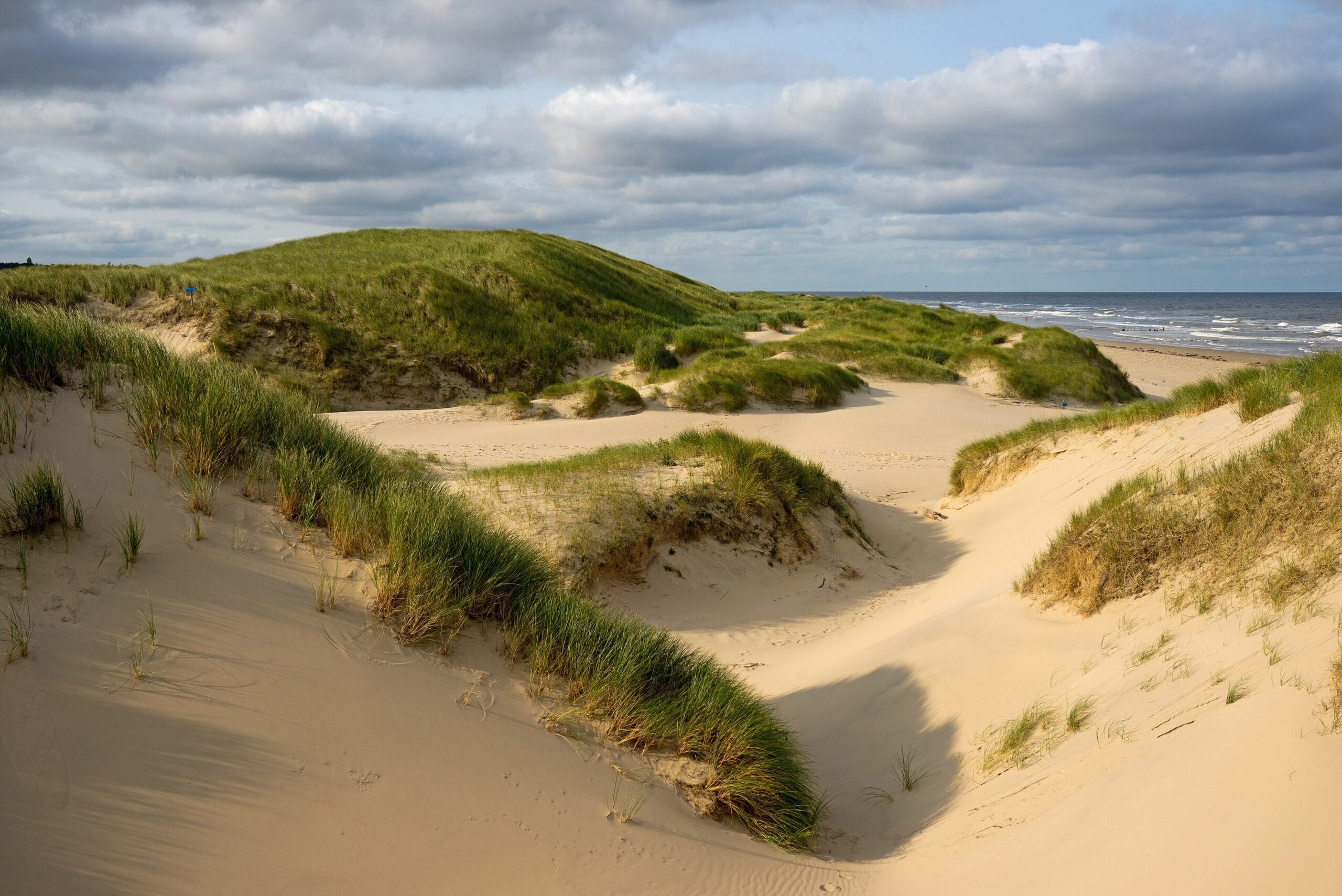
The dunes start a 20-minute walk west of the village. The Schoorlse Duinen, running north between Bergen and the Hondsbossche sea defense, cover 1,737 hectares and rise to about 58 meters, which makes them the highest dunes in the country and, at up to 4 kilometers across, the widest. Inside that strip there is a seaward ridge, broad valley complexes, parabolic dunes and a dune lake called the Vogelmeer. Roughly 950 hectares is planted forest, mostly Austrian pine. On the trails you can go from pine shade to open sand within a few hundred meters, and the light changes completely.
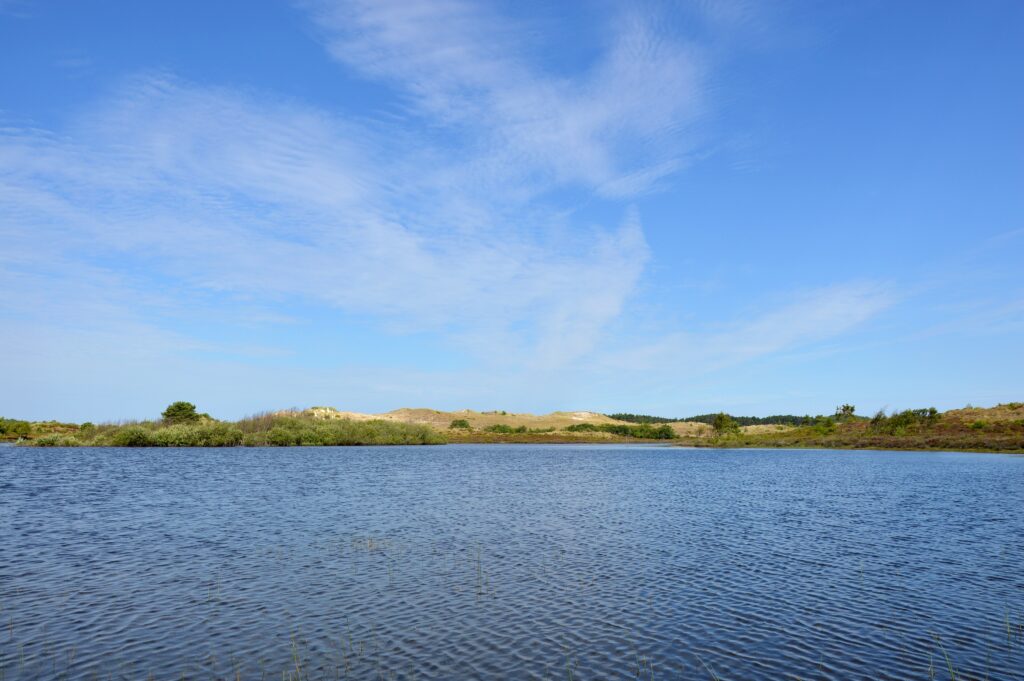
The dunes still move in one place by design, because in 1997 a breach called the Kerf was cut through the sea dune near marker 30.5, letting seawater into the Parnassia valley at high tide so the sand could drift again. The area also holds the last nightjars breeding in the Dutch dunes.
South of Schoorl the Noordhollands Duinreservaat takes over, about 5,300 hectares running some 20 kilometers between Wijk aan Zee and the Schoorl dunes. PWN manages it for the province and was founded in 1920 to extract drinking water, which it still does. Access needs a dune pass, the reserve opens from sunrise to sunset, and cycling on unpaved trails is permitted until 10:30 unless a sign says otherwise.
How Bergen aan Zee was built
Marie Völter arrived at Het Oude Hof in 1873, a 19-year-old German governess hired by the Van Reenen family, and married the eldest of their 12 children, Jacob, who became mayor of Bergen. Around 1900, seaside resorts were going up along the Dutch coast while Bergen was still a poor farming village, and she decided it should have one. She had the Zeeweg laid through to the beach first, and villas, hotels, colony houses, a park and a tennis court followed, with H.P. Berlage and the landscape architect Springer contributing designs and the biologist Jac. P. Thijsse working on the park.

Much of it was then lost. Villas were demolished during the Second World War and Berlage’s bath hotel went with them, though its foundations are still in the ground. What remains is small, 420 residents in 2025 across 1.45 square kilometers. The Bello steam tram reached Bergen in 1905 and the coast in 1909 and closed in 1955, and the locomotive now runs on the museum line between Hoorn and Medemblik.
Getting to Bergen from Amsterdam and Schiphol
No train has reached Bergen since the tram closed, so Alkmaar is the railhead. The usual route is a train from Amsterdam Centraal to Alkmaar, then bus 166 from the station forecourt into Bergen, roughly 1 hour in total. The train takes about 35 minutes and the bus about 15, so check the bus times before you leave. Driving is about 44 kilometers and close to 40 minutes without traffic, and from Schiphol you also take the train to Alkmaar, usually with 1 change. Once you are there a bicycle beats a car, since the dune reserve is closed to motorized traffic and parking at the entrances is free.

Planning a week on the coast
If the dates can be chosen, October brings the Kunst10Daagse, a free festival running in Bergen and Bergen aan Zee since 1993, with more than 350 artists exhibiting at about 160 locations open daily from 11:00 to 17:00. It draws around 40,000 visitors a year and grew out of the Bergen School tradition. The 2026 edition ran from 16 to 25 October, and the 2027 dates have not been announced yet, so check them before you book. Alkmaar deserves a day of its own, partly because the Stedelijk Museum there holds the other significant Bergen School collection.
Our Knit the Landscape retreat runs from 19 to 25 September 2027 at Blooming, a former school building inside a nature reserve outside Bergen, with the sea 15 minutes away by bike. Maaike van Geijn, who teaches the week, lives at Schoorl a few kilometers up the coast, and the colors in the retreat design come from the dune walks she leads. In September the Dutch summer holidays are over and the festival has not started yet, so the dunes are quieter.
Bergen itself takes 1 or 2 days, so plan the rest of the week around the coast and Alkmaar. For what else is running in Europe that year, see our list of craft retreats in Europe in 2027, and for the question of whether a week abroad earns the flight, we have written about how that decision usually goes.