
Portuguese embroidery is less a single craft than a set of regional traditions, each with its own thread, stitches and rules. The three best known come from Castelo Branco, Viana do Castelo and Guimarães, and all three are now protected by certification, so a certified piece can be traced to an approved workshop and an embroiderer who followed a written specification. If you are traveling in Portugal and want to see the work, buy a piece or learn a stitch, it helps to know how the three differ and where each is still made.
Key takeaways
- Castelo Branco embroidery is natural silk on linen, worked mostly on large bedspreads called colchas. It entered Portugal’s national inventory of intangible heritage in 2025.
- Viana do Castelo embroidery uses cotton thread in red, blue or white on linen or cotton, with hearts and stylized camellias as its signature motifs.
- Guimarães embroidery is worked in one thread color per piece, chosen from six, and draws on a codified set of 21 stitches.
- Certified pieces carry seals from the certifying bodies. Printed imitations sold as handmade have been a problem in Viana for years, so check the label.
Telling Portuguese embroidery traditions apart
The quickest way to identify a piece is to look at the thread before the pattern. Silk with a soft sheen, laid in long stitches across a linen ground and densely filling flowers and birds, points to Castelo Branco. Bright cotton in red or blue, with hearts and camellias outlined in small stitches, is almost always Viana. A cloth decorated in a single color, often red or blue on white linen, with a crisp, slightly raised texture, is likely Guimarães.
Each of these rules is written down. Portugal certifies traditional crafts through specifications, documents that set out the permitted materials, stitches, colors and area of production, and a certified piece must follow them. The three traditions in this article all hold geographical indications, and Castelo Branco has gone further with national heritage status. Other regions have their own work (Madeira’s whitework, the drawn-thread embroidery of Nisa, the wool rugs of Arraiolos, which are embroidered rather than woven), and our glossary of Portuguese textile traditions covers them.
Castelo Branco silk on linen
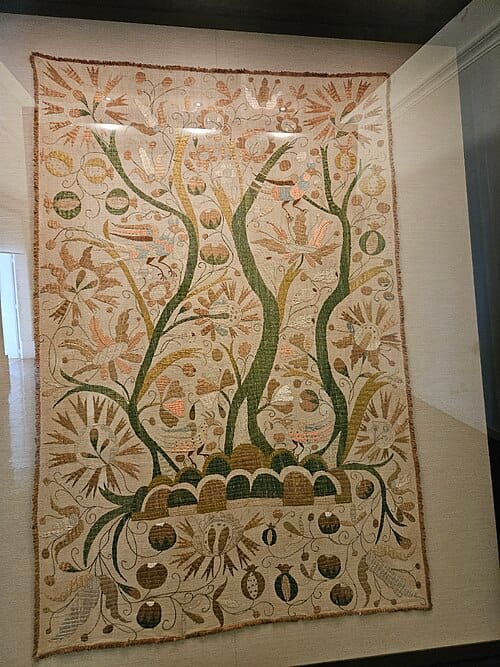
Castelo Branco sits in the Beira Baixa, close to the Spanish border, and its embroidery is the most luxurious of the three. The work is natural silk on linen or half-linen (a cloth with a cotton warp and a linen weft), and its principal product has always been the colcha, a bedspread large enough to cover a bed and hang over the sides. The municipality’s own history dates the tradition probably to the seventeenth century, with its peak in the eighteenth and the first half of the nineteenth, and traces its designs to a mix of Chinese and Indian textiles and European decorative arts. Those were the centuries when Portuguese ships carried painted cottons and embroidered silks back from Asia, and the colchas show it.
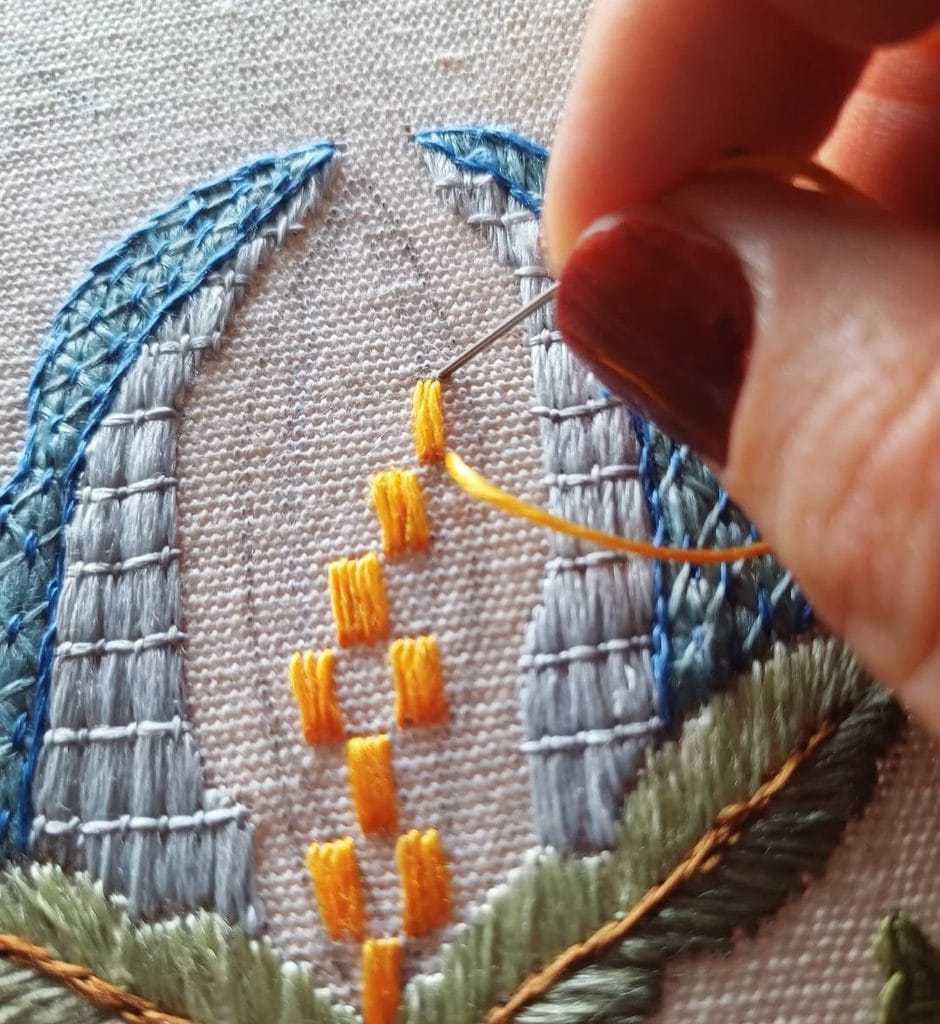
The stitch that defines the work is known today as ponto de Castelo Branco, and older sources call it ponto largo or bordado a frouxo. The embroiderer lays long strands of silk across the fabric and then holds them down with small tie stitches, which covers large areas with relatively little thread. The motifs follow a recognizable vocabulary. According to the national heritage notice and the certification specification, they include the tree of life, carnations, lotus flowers, birds, peacocks, vases and human figures in eighteenth-century dress, often arranged around a central medallion. Birds in pairs stand for a married couple, and pomegranates for a united family.
By the late 1800s the embroidery survived only as domestic work. Its revival took most of the twentieth century. A royal visit by King Carlos and Queen Amélia at the end of the nineteenth century brought attention to the colchas, a school opened in 1940, and in the 1950s Elísio José de Sousa founded a workshop known as the Oficina Casa-Mãe. The regional embroidery workshop attached to the Museu Francisco Tavares Proença Júnior followed in the mid-1970s, and it still trains embroiderers. Since July 2017 it has worked inside the Centro de Interpretação do Bordado, a sixteenth-century building on Largo Camões.
Certification came in stages. The embroidery was registered as a geographical indication in 2018, and the specification requires natural silk (viscose and synthetics are excluded) and production within the Castelo Branco district. On 31 January 2025 it was inscribed in the national inventory of intangible cultural heritage. The inscription is candid about the risks, citing the small number of embroiderers and the difficulty of finding quality raw materials. The heritage file counts about five full-time embroiderers at the interpretation center and around ten professional certified embroiderers in the district. A full colcha takes a single embroiderer about a year, and the cultural magazine Gerador reported prices between roughly EUR 10,000 and EUR 50,000. Most new work is smaller, in panels and cushions that suit a modern house.
Viana do Castelo hearts and camellias
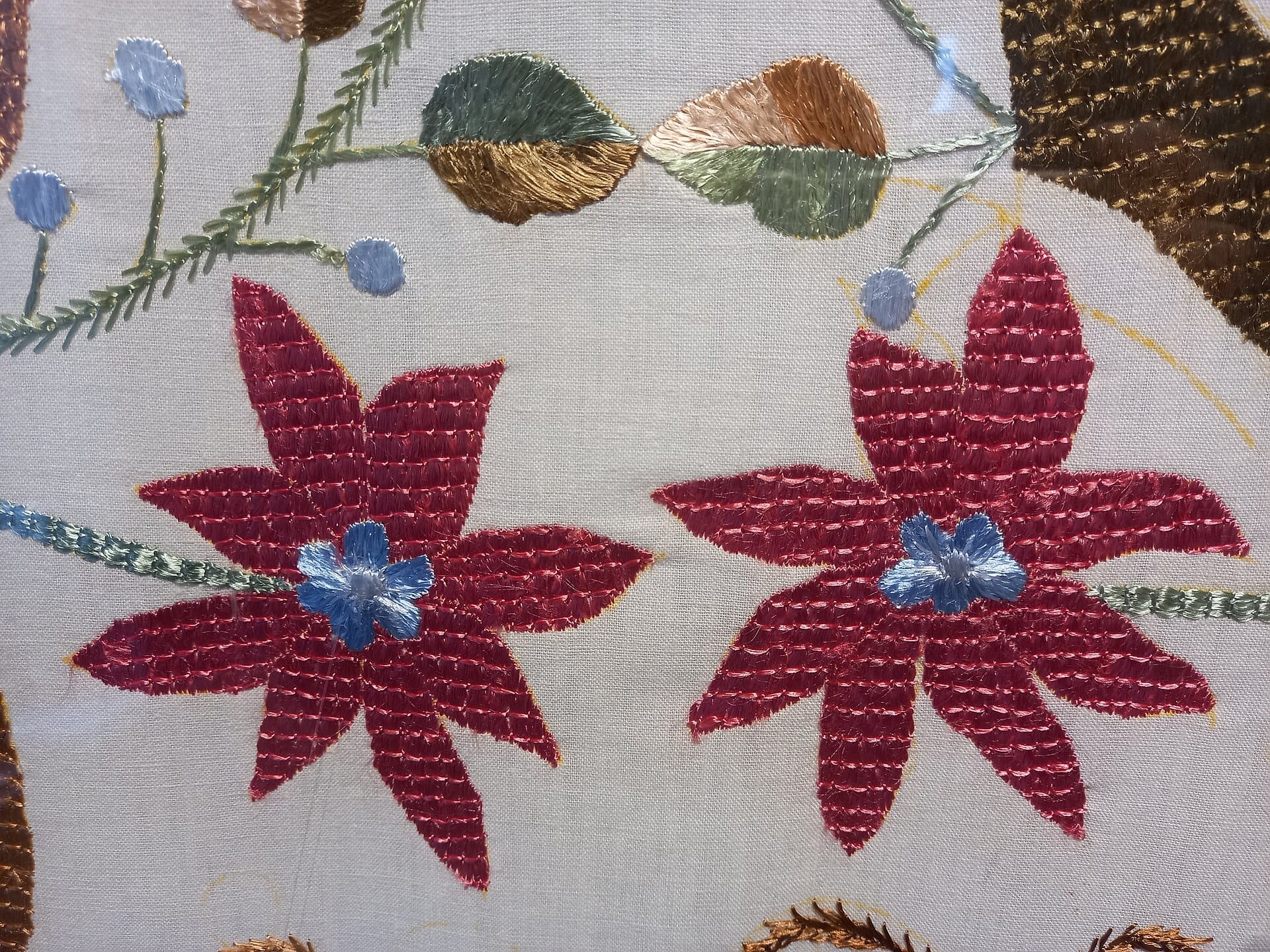
Viana do Castelo, on the Atlantic at the mouth of the Lima River, gives its name to a brighter and more graphic style. The certification specification sets the ground as linen or cotton in a plain taffeta weave and the thread as cotton perlé in white, blue and red, the red and blue often paired with white. Historic pieces also show salmon, yellow and black. The central motifs are the heart and the japoneira, a stylized camellia, accompanied by clover, carnations, daisies, stars and scrolling stems. The stitches include simple openwork, running stitch, stem stitch and a local stitch called trinca-fio, which the specification singles out as the style’s most original.
The embroidery grew from domestic needlework on aprons, tablecloths and handkerchiefs. It took a public, commercial form in 1917, when the Cruzada das Mulheres Portuguesas, a women’s organization, exhibited it, and when Gemeniana Branco Abreu de Lima turned the work into a business whose pieces won medals in Braga and Seville. The municipality applied for protection in 2005, and the geographical indication was granted on 9 September 2011. The first certified pieces went on sale in August 2012, during the town’s great summer festival. At the time, artisans told Rádio Vale do Minho that printed copies passed off as handmade had undercut them for more than a decade, which is why certified work now carries two seals, one on paper and one sewn into the fabric. The municipality lists six certified makers on its website.
Lenços de namorados
The sweetheart handkerchiefs of the Minho are a separate certified product, although they come from the same region and share much of the imagery. A young woman embroidered a square of linen or cotton for the man she hoped to marry, with hearts, keys, birds and lines of verse, and if he wore it in public the courtship had been accepted. The oldest surviving examples date from the late nineteenth century, though the custom probably adapts aristocratic handkerchiefs of the seventeenth and eighteenth centuries. The verses are often misspelled, because the embroiderers wrote them the way they spoke, with limited schooling, or copied errors from printed patterns. Certification began in 2002 under ADERE-Minho, making the handkerchiefs Portugal’s first certified craft product, and in May 2026 they became the first Portuguese craft to receive the European Union’s new geographical indication for craft and industrial goods, as RTP reported. The Aliança Artesanal cooperative in Vila Verde, founded in 1988, has kept the craft going.
The heart in gold
The heart motif also appears in the gold filigree of the Minho, where the Coração de Viana is worn with the region’s traditional dress. Popular accounts link it to devotion to the Sacred Heart and to a legend about Queen Maria I, though they present that story as one version among several. Most filigree hearts are made today in Póvoa de Lanhoso and Gondomar rather than in Viana itself. In Viana’s souvenir shops the heart turns up on almost everything, in silver, enamel and even cork, and very little of it has any connection to the embroidery. If you want the real thing in thread, look for the certification seals.

Guimarães one color at a time
Guimarães, the town that calls itself the cradle of Portugal, has the most disciplined of the three styles. According to the specification written with the Museu de Alberto Sampaio, the embroidery developed in the late nineteenth and early twentieth centuries from the white and “rich” embroidery of prosperous households, and it was used above all on the chest panel of a farm laborer’s linen shirt and on women’s shirts and vests. The name bordado de Guimarães first appears in print in 1913. By the 1940s the style had become a regional emblem.
Its rule is that each piece uses a single color of mercerized cotton thread, chosen from six: red, blue, beige, gray, white or black. The ground is usually linen, sometimes half-linen, cotton or silk. The motifs are mostly plants and flowers, with hearts, vases, birds and religious symbols, arranged geometrically or more naturally, and they are worked with a codified set of 21 stitches that includes chain stitch, buttonhole stitch, several forms of pé-de-flor and a raised stitch called canutilho, which the specification describes as nearly obligatory. The single color puts the texture of the stitches forward, and a well-made piece reads almost as relief.
A Oficina, the cultural cooperative of Guimarães, applied for certification in 2006, and the embroidery received its national mark and geographical indication on 22 November 2010. Training courses run by the municipality in 1989 and by A Oficina in 1996 produced most of the embroiderers working today. Sources differ on how many are certified, with A Oficina’s own pages giving both eight and thirteen [confirmar].

Where to see, buy and learn Portuguese embroidery
In Castelo Branco, the Centro de Interpretação do Bordado on Largo Camões opens Tuesday to Sunday, from 10 a.m. to 1 p.m. and 2 to 6 p.m., and its workshop, where you can watch the embroiderers at work, is open on weekdays from 9 a.m. to 12:30 p.m. and 2 to 5:30 p.m. The center runs courses and sells pieces through an online shop with pickup on site. Historic colchas hang in the Museu Francisco Tavares Proença Júnior, housed since 1971 in the former bishop’s palace, which opens Tuesday to Sunday from 10 a.m. to 6 p.m.
In Viana do Castelo, the Museu do Traje on Praça da República shows the linen and wool dress of the Alto Minho, including the embroidered aprons and the gold that goes with them. It opens Tuesday to Friday from 10 a.m. to 6 p.m. and at weekends from 10 a.m. to 1 p.m. and 3 to 6 p.m. The best time to see the costume worn is the Romaria de Nossa Senhora d’Agonia, held each year around 20 August, when women parade in embroidered dress and family gold. The 2026 festival ran from 15 to 23 August, and the 2027 dates should appear on the municipal site in the spring [confirmar]. Certified makers are listed on the municipality’s website, and the lenços de namorados can be bought from the Aliança Artesanal in Vila Verde, inland near Braga.
In Guimarães, the Loja Oficina at Rua Rainha D. Maria II 132 sells certified handkerchiefs, towels and napkins and runs occasional open workshops. In January 2025 it offered three Saturday sessions taught by the embroiderer Sameiro Fernandes for EUR 15 in total, and it is worth asking whether another is planned [confirmar]. The Museu de Alberto Sampaio, whose curators helped write the embroidery’s specification, opens Tuesday to Sunday from 10 a.m. to 6 p.m., with adult tickets at EUR 5.
Whichever town you visit, buy certified work when you can. A certified piece costs more than a printed tea towel, and the difference goes to the small number of people who still know how to make it. Our guide to Portugal for makers places all three towns on a wider route through the country’s crafts, and the textiles glossary covers the lace, rugs and cloth you will meet along the way.