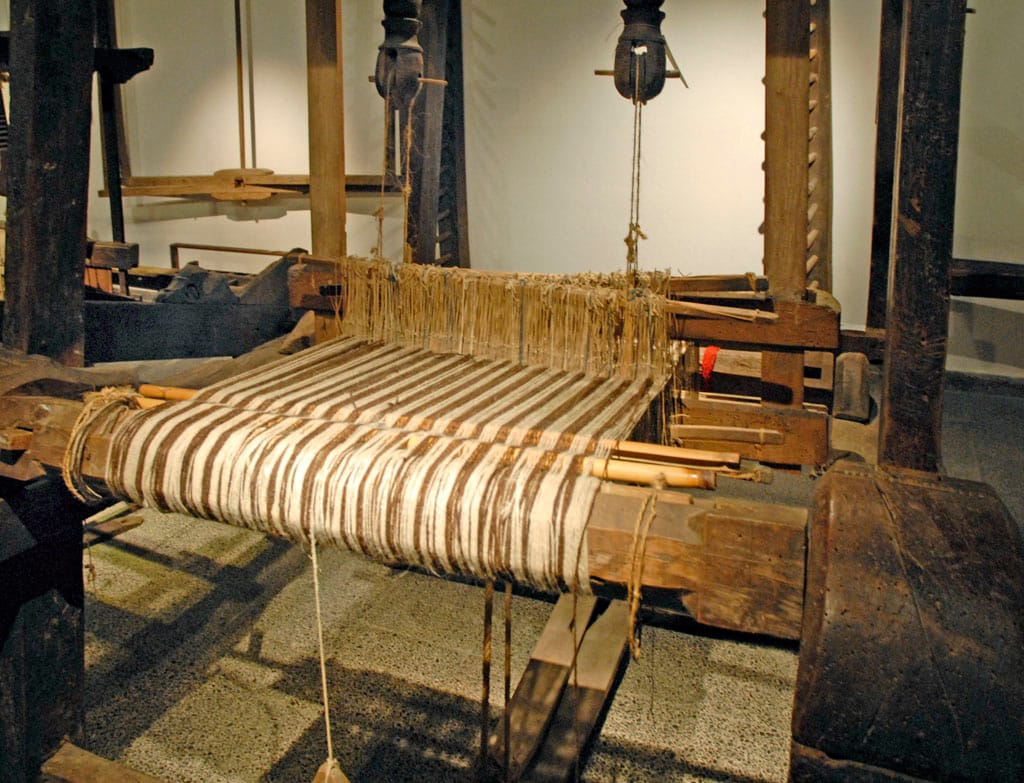

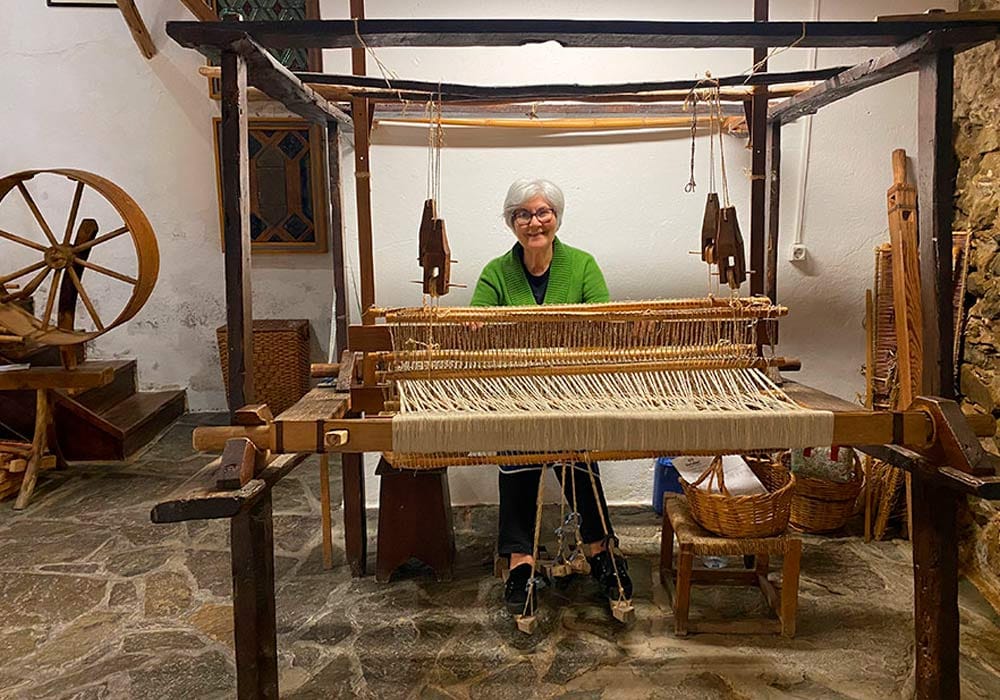
Two women over sixty work the looms at the weaving cooperative in Mértola, and a third does the carding and spinning. At the one surviving factory making the Alentejo blanket, four weavers have produced essentially every manta alentejana of the past twenty-five years. Those numbers are the real subject of any honest account of Portuguese weaving, and they sit oddly beside a textile export sector with roughly five thousand companies and well over a hundred thousand jobs. Portugal still weaves at industrial scale. The hand traditions behind that industry now rest with a few named people in specific villages.
Key takeaways
- The manta do Alentejo has a documented regional identity from the fourteenth century, and 1508 records show the blankets exchanged for gold and enslaved people at the Arguim fortress.
- Arraiolos rugs are embroidered, not woven. The only loom in the whole process is the small frame used for the fringes.
- The ponto de Portalegre knots a second wool thread over every thread of a plain weave, giving 2,500 points per square decimeter from a palette of more than 7,000 wool colors.
- Three artisans in the village of Sendim hold the knowledge of the Mirandese capa de honras, which the Portuguese state inscribed in 2022 as needing urgent safeguarding.
The manta alentejana and six centuries of stripes
The Alentejo blanket is the oldest continuously made Portuguese textile with a documented regional identity, which the academic work on it places in the fourteenth century. It was woven from the Serra Algarvia up into the Baixo Alentejo, in Mértola, Alcoutim, Castro Verde and Almodôvar, from merino and campaniça wool. The earliest reference is a will of 1395 listing, among the cloaks and sheets, one new blanket from beyond the Tagus.
Two decorative systems run through it. The manta de riscas is striped and everyday, while the manta grave, also called montanhac, carries geometric figures and was the formal version. The grammar of those figures comes out of Berber material culture, which is where the trade history turns interesting. Portuguese merchants used the manta as a substitute for the North African hanbel, a cloth with the same vocabulary of stripes and geometry but woven on a vertical loom rather than a horizontal one. Documents of 1508 show the blankets making up around a fifth of transactions at the Arguim fortress, traded for gold and for enslaved people, with an ordinary manta going for 2.5 dobras against 5 for a hanbel. Gil Vicente put the blanket into a farce in 1525.
Mértola and Reguengos, the two workshops left standing
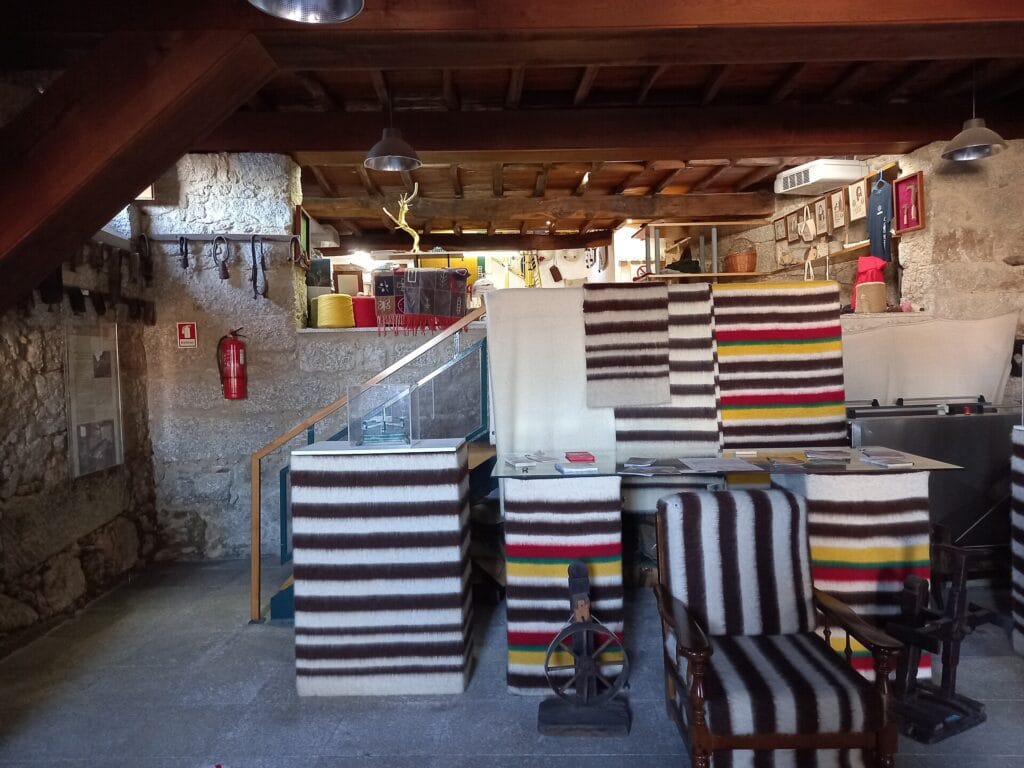
The Cooperativa Oficina de Tecelagem de Mértola was founded in the 1980s and now doubles as a nucleus of the Museu de Mértola. Helena Rosa and Fátima Mestre work the looms, with Vitorina carding and spinning. Helena Rosa has been at it for more than thirty years and led the cooperative for thirteen. Sixteen women once worked there, most leaving for better-paid jobs. A wool blanket measuring 1.90 by 2.20 meters takes about two months, from regional merino or campaniça wool carded, spun and woven by hand, with indigo for the characteristic blue. Beyond the montanhac and the stripes they weave colchas de carapulo, which set a wool weft on a linen warp with pulled-thread work. The museum links the motifs directly to decoration on ceramics from Mértola’s Islamic period, and excavations at the Alcáçova turned up spindles, distaffs and loom weights.
You can visit at Rua da Igreja 35, Tuesday to Sunday, roughly 9:20 to 12:30 and 14:00 to 17:20, though published hours differ between the museum and the tourism office and no admission price appears anywhere we could find. The cooperative also hosts design residencies and trains apprentice weavers.
Reguengos de Monsaraz holds the other survivor. In the 1950s José Rosa consolidated the small local blanket businesses into the Fábrica Alentejana de Lanifícios, which took a gold medal at the 1958 Brussels World’s Fair, and in 1977 the Dutchwoman Mizette Nielsen took it over and spent decades as keeper of its original patterns. Three Portuguese owners bought it in January 2020 and rebranded it Fabricaal. The plant occupies a converted olive-oil mill and runs eleven manual looms from 1.20 to 2.40 meters wide, weaving patterns whose names describe what you are looking at, espinha for herringbone, then castelos, losangos and fusos. A blanket of 2.40 by 3 meters takes about three days, quick next to Mértola.
Burel, the cloth the mountain made
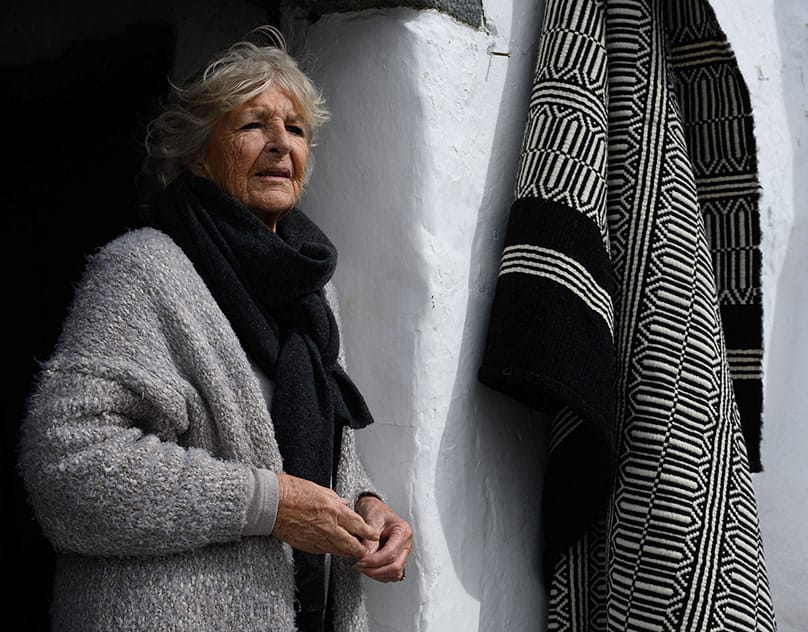
Burel is woven wool that is then fulled, beaten and scalded in hot water until the weave closes on itself. What comes out is dense and close to waterproof, in colors running from brown to black, and shepherds in the Serra da Estrela wore it as capes for centuries. It is made from Bordaleira da Serra da Estrela fleece, and the fulling separates it from ordinary cloth.
Ecolã in Manteigas has been in the Clara family since 1925. João Clara de Assunção took over in 1995 after his father died suddenly, and his daughter Joana Clara now runs operations alongside him. It marked its centenary in 2025, employs around twenty-five people, exports more than half its output to sixteen countries, and weaves on mechanical looms from the 1960s. A few doors along, Burel Factory occupies the former Lanifícios Império, which opened in 1947 as the region’s most important wool factory. Isabel Costa and João Tomás found it in ruins and rescued it from insolvency around 2010 and 2011, by which point the eleven factories that had worked in the area were down to this one. It employs sixty-five people and runs four generations of looms, including nineteenth-century machines. A blanket takes two weeks from raw fleece through carding, spinning, weaving and finishing, with about ten people touching it. Tours run Monday to Saturday at 11:00 and 16:00 by booking, at 5 euros a head.
One figure explains why all of this is precarious. A Serra da Estrela shepherd named Américo Albuquerque sells his wool at 1.80 euros a kilo and pays 2.50 euros a head to have the sheep sheared. The fleece costs more to remove than it earns.
Arraiolos rugs are embroidered, not woven
This is the correction worth making loudly, because most English-language accounts of Portuguese textiles get it wrong. The Arraiolos tapete is needlework. Wool is embroidered onto a counted-thread canvas ground in an oblique cross stitch worked two by two, which the trade calls the ponto de Arraiolos, with an older stitch, the pé-de-flor, outlining motifs before cross stitch fills them. The work proceeds in named phases, the armação that outlines, the matiz that shades the interior and the enchimento that fills the background. The only loom anywhere in the process is the small Arraiolos fringe loom used at the end.
The documentary record starts in 1598, with a municipal inventory valuing a new carpet of the land at two thousand réis, belonging to Catarina Rodrigues, a farmer’s wife. A 1608 inventory names Juliana Dordio, who owned a carpet in progress and yarn for carpet-making, and who may be the oldest Arraiolos carpet-maker whose name survives. Two origin theories compete, one tracing the craft to Alentejo convents, the other to Moorish families who moved south after 1496. The eighteenth-century dyes were indigo, brazilwood, madder, dyer’s iris and woad, giving eighteen recorded color variations. It was a household industry organized by gender, with women spinning and dyeing, men carding, and children gathering the dye plants. By 1892 Sousa Viterbo wrote that he did not know whether carpets were still made in Arraiolos at all.
The state record counts 129 women producing continuously in 2017 and 2018, mostly aged between forty and eighty, with transmission to younger generations described as sporadic. More than twenty carpet companies existed in 2002 and fewer than half remained by 2016. A square meter takes two to three weeks and sold around 2016 for roughly 250 euros. The craft entered the national intangible heritage inventory in September 2021, and the IEFP issued a provisional certification in November 2025 after Arraiolos fought off attempts to widen the protected production area. No Portuguese textile craft is on any UNESCO list, and Arraiolos submitted a candidacy in October 2025. The Centro Interpretativo do Tapete de Arraiolos opens Tuesday to Sunday on the Praça do Município, where sources give the street number as either 19 or 27 and no admission price is published.

Portalegre and the stitch invented in Roubaix
In 1946 Guy Fino and Manuel Celestino Peixeiro set out to revive tapestry in Portalegre, using a stitch that Peixeiro’s father, Manuel do Carmo Peixeiro, had invented while studying textile arts in Roubaix in northern France. On a conventional European high-warp loom the colored weft covers the warp. In the ponto de Portalegre the cloth is first woven in plain weave, and then every single thread is covered by a wool knot. Work goes on vertical looms, from the reverse side, starting at the bottom, at 2,500 points per square decimeter drawn from more than 7,000 wool colors. The back of a Portalegre tapestry mirrors the front with the same definition, which is the proof that each knot passes through the full thickness of the cloth.
The first tapestry, designed by João Tavares, was finished in 1947 or 1948 depending on the source. Júlio Pomar, Maria Keil, Vieira da Silva, Almada Negreiros and Eduardo Nery all worked with the manufactory, and more than two hundred painters contributed designs, producing roughly 3,400 tapestries from over 2,500 original drawings. Jean Lurçat, who did more than anyone to revive French tapestry, visited in 1958 and afterward called the Portalegre weavers the best in the world, commissioning from them until his death. The April Revolution of 1974 nearly erased the American export market overnight, and the manufactory now works in limited editions of one, four or eight numbered pieces, in the former Jesuit Colégio de São Sebastião that became the Royal Wools Factory in 1772. The Museu da Tapeçaria de Portalegre Guy Fino, open since July 2001, holds work by Almada Negreiros, Vieira da Silva, Le Corbusier and Lurçat.
What to call the parts of a Portuguese loom
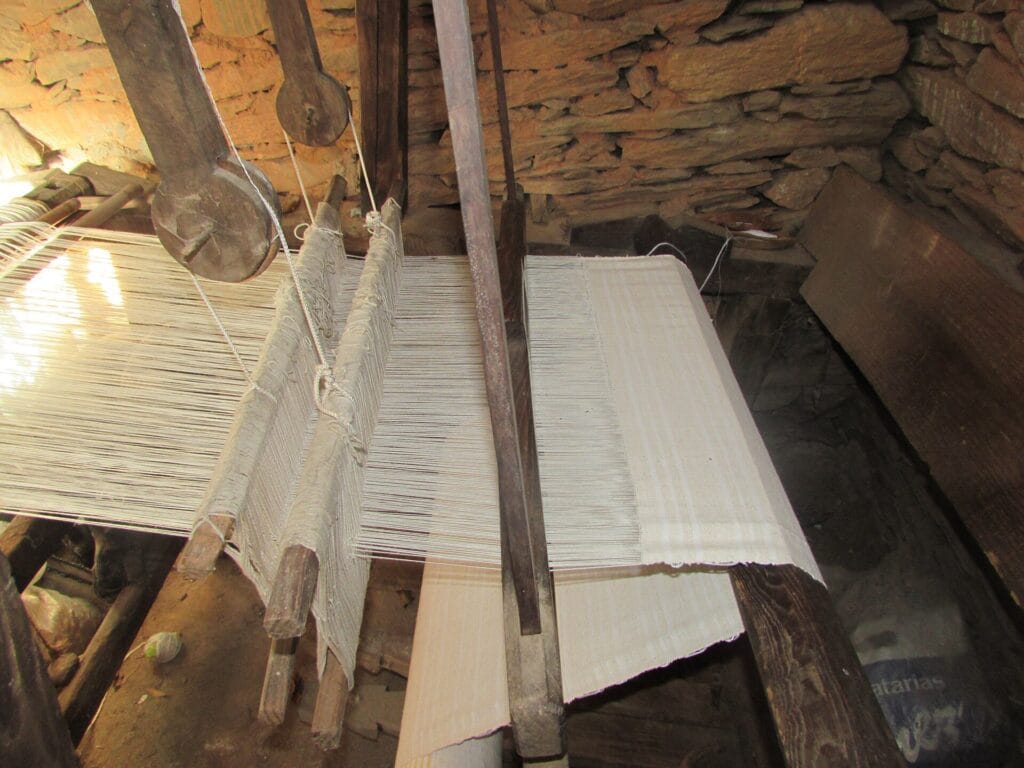
Two systems of thread make a cloth. The urdidura, also called the teia, is the warp held under tension, and the trama is the weft carried across it. The lançadeira is the shuttle, the pente separates the warp threads and beats the weft into place, the liços raise selected warp threads, and the pedais work the harnesses to open the cala the shuttle passes through. A loom takes its name from how many liços it has, so a tear de quatro liços does pattern work a two-shaft loom cannot. Before any of that, carding happens in two passes, emborrar for the coarse fibers and imprimir for the fine, and spinning uses the roca with its roquil alongside the fuso or the roda de fiar. The cloth as it leaves the loom is the enxerga.
What Portuguese weaving looks like now
The industry and the craft have come apart. Portugal’s textile sector runs on roughly five thousand companies, employed just under 140,000 people in 2019, and accounts for about a tenth of national exports, concentrated around Porto, Braga, Guimarães and Famalicão, with Covilhã holding the wool end. Covilhã once had more than two hundred companies and now has about a dozen.
Alongside that, the hand traditions survive as named individuals. Three artisans in Sendim make the Mirandese capa de honras, a burel cape whose earliest documented reference is 1819 and which the state inscribed in November 2022 with an explicit note that the knowledge needs urgent safeguarding. Two artisans in Freixo de Espada à Cinta, Júlia Braz and her apprentice Liliana Esteves, keep handmade silk going, boiling cocoons in copper cauldrons to draw filaments around a thousand meters long. Várzea de Calde in the Viseu district has about thirty-five linen artisans aged between thirty and eighty-five, none full-time, working the flax cycle from sowing through retting and scutching to the loom. The state has started treating this as policy rather than nostalgia. Programa Saber Fazer, approved in October 2020 and funded through the EU recovery plan, documents at least thirteen traditional crafts with an atlas, routes and a national directory of artisans, and in September 2026 the government moved to make that support permanent.
Where to see and learn traditional weaving in Portugal
The Museu de Lanifícios of the Universidade da Beira Interior in Covilhã is the serious one. It occupies the Real Fábrica de Panos, founded by D. José I in 1764, and keeps three visitable nuclei, among them the Pombaline cloth factory with its dye works and the open-air Râmolas de Sol with its historic sun-drying racks. It opens Tuesday to Saturday, with ticket prices the museum’s own pages do not publish.
For learning rather than looking, LOOM New.Tradition works out of Évora, Viana do Alentejo and Mértola, teaching loom weaving with graphic pattern reading, natural dyeing, hand spinning and felting, and running guided visits to the Mértola cooperative in English, Portuguese and Spanish. Isabel Cartaxo runs a four-hour wool-to-cloth workshop at Vila Nova da Baronia near Alvito, covering fleece characteristics before washing, carding, spinning and weaving a piece to take home, at 130 euros a person. In Lisbon a weaver named Andreia teaches four-shaft hand weaving over sixteen hours across four days. Contextile, the textile art biennial in Guimarães, runs from 5 September to 29 November 2026 on the theme Por um Fio.
Why the distinctions are worth keeping
Calling an Arraiolos carpet woven, or filing burel and the manta alentejana under one heading because both are wool blankets, loses what makes each specific. Mértola’s geometry descends from Islamic ceramics and takes two months a blanket, while Reguengos weaves herringbone at speed. Burel is defined by the fulling that comes after the weaving. Arraiolos is embroidery copying Persian carpets, and Portalegre is a knot invented in a French textile school to reproduce oil paintings in wool.
For the fibers underneath all of it, see Portuguese wool and the yarn we knit with, and for the wider set of traditions the glossary of Portuguese textiles. The regional embroidery traditions of Viana, Castelo Branco and Guimarães are the companion to the Arraiolos section above. Our own weeks sit at the knitting end of this, with the Colorwork Knitting Retreat in the Algarve working in Portuguese-spun wool on the west coast and Knit the Landscape doing the same in the dunes of North Holland.