
Say Algarve to most Americans and they picture the south coast. Marinas, golf, a wall of hotels running from Faro to Lagos.
Carrapateira sits on the other coast, the western one, where the cliffs face open Atlantic and the nearest hotel strip is an hour’s drive away. Two hundred people live there, and the village has neither an ATM nor a pharmacy. What it does have is a three-kilometer beach, a cliff path that runs over the remains of a twelfth-century fishing village, and an evening light that tends to stop conversation. Our Algarve retreat runs here, and this is how we would spend a week in it.
Key takeaways
- Carrapateira sits inside the Southwest Alentejo and Vicentine Coast Natural Park, 35 kilometers north of Lagos. It is a fishing and farming village that surfing found. It is not a resort.
- Come in late May or early June. Around 19°C by day and almost no rain. The summer wind has not started yet.
- You want a car. Lisbon is three and a quarter hours by road. Faro is an hour and a quarter.
- Eat the fish, the percebes and the Aljezur sweet potato. The best cliff restaurant closes on Mondays.
Where Carrapateira is, and why it is not the Algarve you picture
Carrapateira sits in the parish of Bordeira, municipality of Aljezur, at the top of the Algarve’s west coast. Everything from here north into the Alentejo is protected as a natural park. That is why the cliffs are still bare and the villages are still small, and why they will stay that way.
The village itself is a few streets of whitewashed houses gathered around a sixteenth-century church, with a grocery, a couple of cafés, and a fort that was built in 1673 to watch for Barbary pirates and has been a ruin since 1792.
Farming village until the 1950s, then a fishing one. Ten fishermen and six boats still work the rocks at Zimbreiranha and Sítio do Forno. In 2000 there were nineteen of them. They run long lines for sea bass and bream, set pots for octopus, and gather percebes, the goose barnacles this coast is competitive about.
Then surfers found Praia do Amado. The village got surf schools, a few good restaurants and a second language. It never got a hotel strip. Inside the park it never will.
The village museum, the Museu do Mar e da Terra, opened in 2008 and tells that story with fishing gear, farm tools, photographs and the testimony of people who lived it. Weekday mornings, EUR 2.70. Go on your first afternoon, before you walk the headland. You will read the rock differently afterward.
The landscape, and what it does to color and light
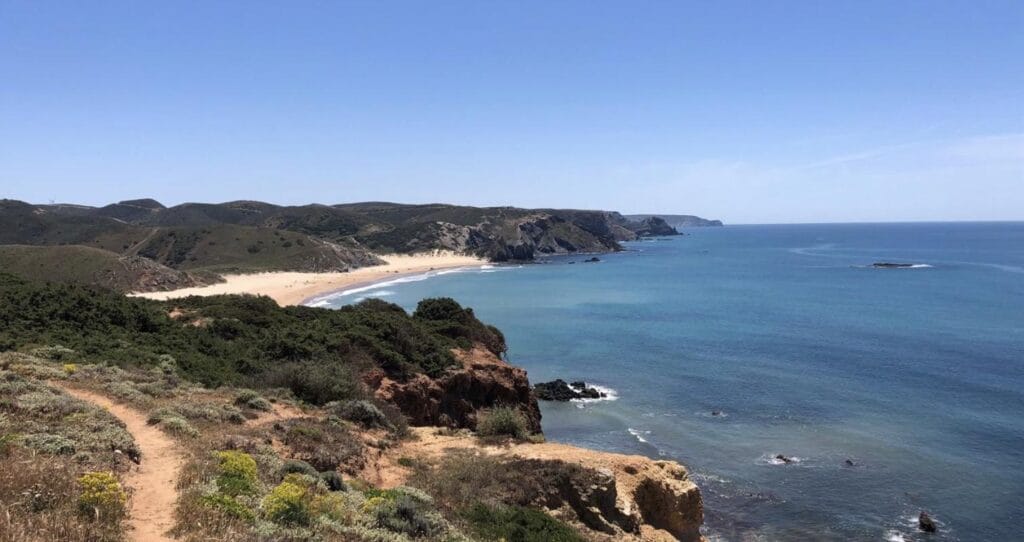
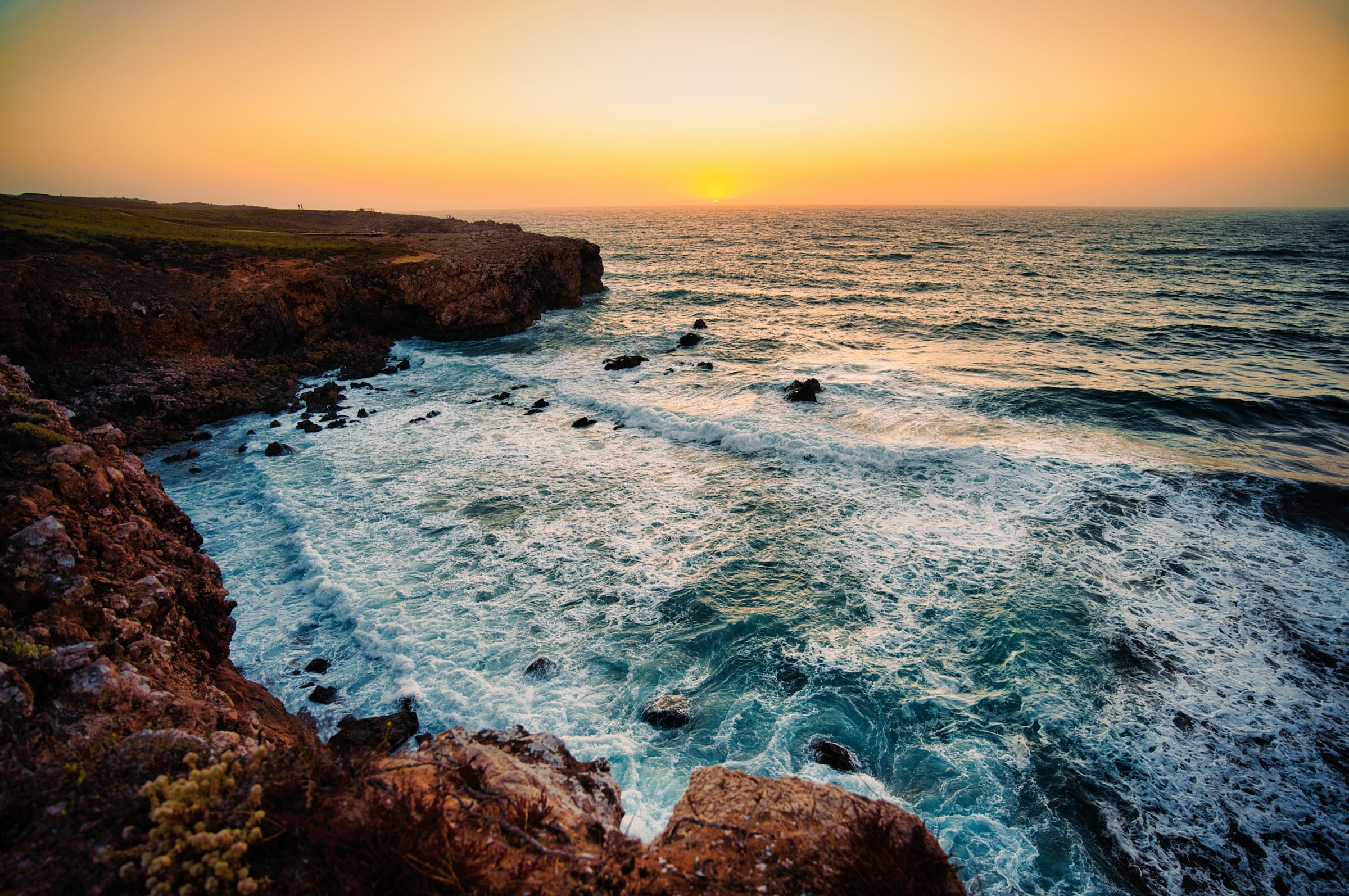
Walk out onto the Pontal, the headland between the two beaches, and you are standing on about 150 million years of rock. Jurassic limestone on top, weathered into arches and columns. Dark schist and quartzite underneath. The Amado end is pink and red and ochre. The south end of the beach is nearly black. Between them the Bordeira river runs out through the dunes into a shallow lagoon, and the sand behind the beach reaches inland almost to the village.
In late May the dunes come into flower, and you will walk past sea thrift, wild snapdragon, honeywort, blue pimpernel and candytuft without especially trying. Cistus is everywhere, the sticky white rockrose that starts smelling of resin once the day warms up, and dune thyme and everlasting hold the sandy ground between them. White storks nest on these sea cliffs, which they do nowhere else on earth, and choughs and peregrines work the headland above you.
This is where the retreat’s color palette comes from: the ochre of the Amado rock, the gray-green of the thyme, the dark of the schist, the blue the Atlantic turns at eight in the evening.
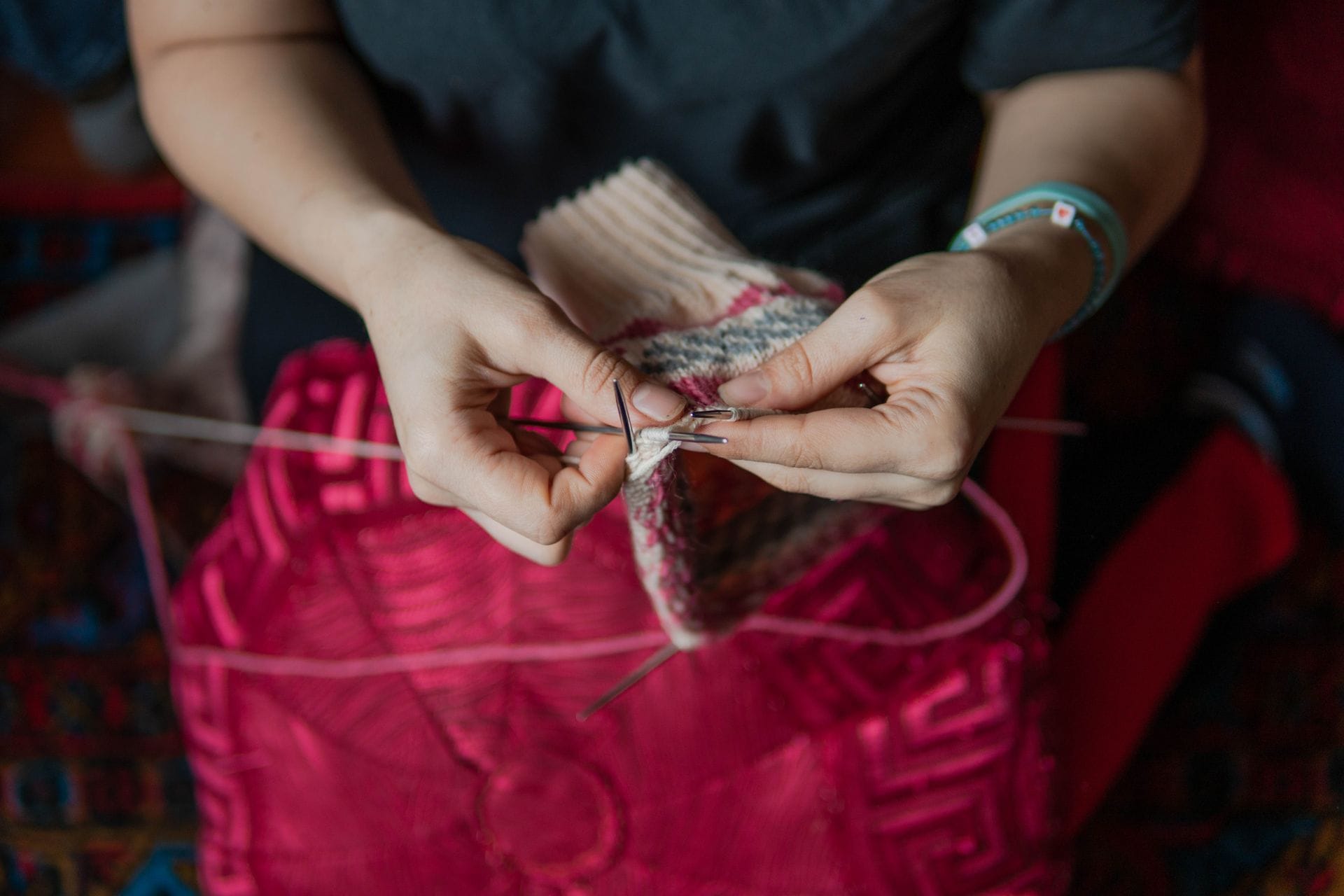
Then there is the light. The coast faces west with nothing between it and Newfoundland, so the evenings run long and nothing blocks the sunset. In late May the sun goes down close to nine, and the Amado cliffs turn red for the last half hour of it. We have watched a table of knitters stop mid-sentence for that.
Every color in the retreat kit is on this headland. You just have to walk it once to see where.
The two beaches and the cliff path
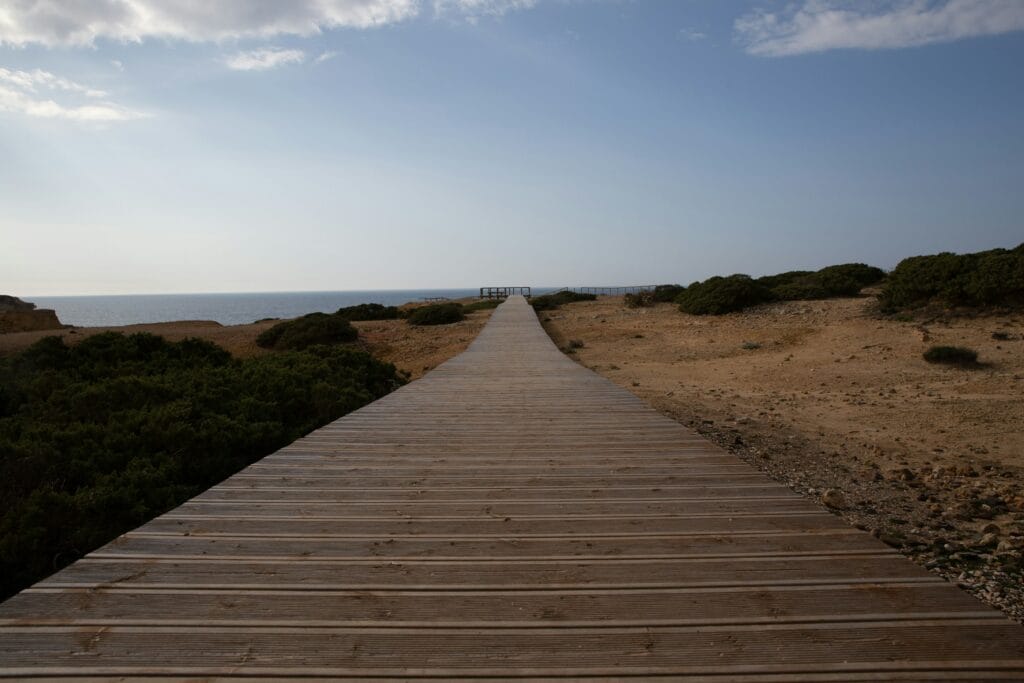
Praia da Bordeira is the big one. More than three kilometers of sand, the longest on the Vicentine coast, with a boardwalk from the car park and a bar that opens in season. The river lagoon at the south end is warmer and calmer than the sea, which is where the non-swimmers end up. The beach is wide open to the wind. On a blowy day, walk it in the morning.
Praia do Amado is five minutes south by car and it is the surf beach: two schools, a big car park, lifeguards in season, national competitions in the fall. The rock at its north end is the pink and ochre you saw from above.
The Pontal trail links the two. It is an 11.5 kilometer circle from the village, three hours at an easy pace, on boardwalk and earth path along the cliff edge. There are wooden viewing platforms, and the excavated remains of an Islamic fishing settlement, a cluster of huts from the twelfth and thirteenth centuries where fish were salted and dried for trade inland.
The Fishermen’s Trail comes through here too, the long-distance Rota Vicentina: 20 kilometers from Arrifana down to Carrapateira, then 15 steep ones on to Vila do Bispo, mostly on sand, walkable September to June. An afternoon on a section of it is one of the retreat’s optional outings. Save the walk back along the top of the Bordeira dunes.
Where to eat, and what to skip
One correction before anything else, because it will save you a drive. Sítio do Rio, the restaurant out in the dunes that every older guide still recommends, has closed. We checked in September 2026.
In Carrapateira
Micro Bar on the Largo do Comércio is the village kitchen. Open every day from lunch until nine. The veggie burger, the eggplant parmigiana and the sangria carry it through the summer.
Sítio do Forno has the best view on this coast, out on the cliff between the two beaches, and a menu of grilled fish, cataplana, tiger prawns and octopus to eat it with. Closed Mondays. Expect to wait for a table at sunset.
Alecrim, on Rua dos Quintais, does pizza and Mediterranean plates and is quietly the best-reviewed place in the village. Restaurante do Cabrita is the traditional fish house.
Worth the drive
Aljezur, fifteen minutes north, has the most interesting food in the area. Pont’a Pé sits by the river in a century-old former inn and cooks octopus with sweet potato, black pork cheeks, cataplana, and a sweet-potato dessert with medronho, the local strawberry-tree spirit. Cera is a natural wine bistro with muxama and smoked anchovies. Arte Bianca makes sourdough pizza that has made a national list.
Out on the Arrifana headland, O Paulo serves percebes and grilled fish and gives you a cliff to eat them over. It is popular, and at the busiest hours the service knows it. In Vila do Bispo, Ribeira do Poço is the percebes specialist and A Eira do Mel does the octopus and sweet-potato cataplana. In Sagres, A Tasca and A Sereia at the port do caldeirada and grilled fish. For a night out, Näperõn in Odeceixe runs tasting menus at big-city prices.
What to order
Percebes, boiled in seawater and eaten with your fingers. Grilled sea bream, which is what the village boats bring in. Fried moray eel if you see it, the old Carrapateira dish. And the Aljezur sweet potato, which has protected status and comes out of the ground in October. It turns up in everything here, cataplana through to dessert. Aljezur holds a festival for it every November, 28 to 30 November in 2026.
Getting there from Lisbon and from Faro
Faro is the closer airport. 110 kilometers, about an hour and a quarter, across the Algarve on the A22 and then north on the N268 from Lagos. Lisbon is 260 kilometers and about three and a quarter hours, down the A2 and across the Alentejo. Both are easy drives until the last stretch from Aljezur, which is a narrow road through cistus scrub. Arrive in daylight the first time.
Without a car it is harder but possible. Rede Expressos runs a direct coach from Lisbon’s Sete Rios station to the Largo do Comércio in Carrapateira, twice a day, four hours ten minutes. Coaches from Lisbon to Aljezur are more frequent and take three and a half to four hours. The train from Lisbon to Lagos is three to three and a half hours with a change at Tunes, and Vamus Algarve buses run Lagos to Vila do Bispo and on to Carrapateira in about two hours, if the timetables line up. They do not always line up.
Our retreat guests skip all of this. The Colorwork Knitting Retreat includes a group transfer from Lisbon and back. Fly into Lisbon, spend a night there if you want to hit Retrosaria for wool, and meet the group the next day.
When to come, and why late spring
Come in late May or early June. Days sit around 19°C (66°F) and nights drop to 15°C (59°F). May gets about an inch of rain across the whole month. The sea runs 16 to 18°C, which is 61 to 64°F. That is cold. People swim anyway, briefly, and come out looking pleased with themselves.
The wind is what actually sets the dates. The nortada blows down this coast most days from June into September, and in late May it has not started. The dunes are still in flower. Those two weeks are the window, and they are the two weeks we booked: 23 May to 5 June.
The off season is real here and worth knowing about. October to April the village is quiet and the Fishermen’s Trail is at its best. Summer belongs to surfers and to people who like wind. Winter is wet but rarely cold, and the Atlantic in a January storm is worth the drive on its own.
Hortas do Rio, where the retreat lives
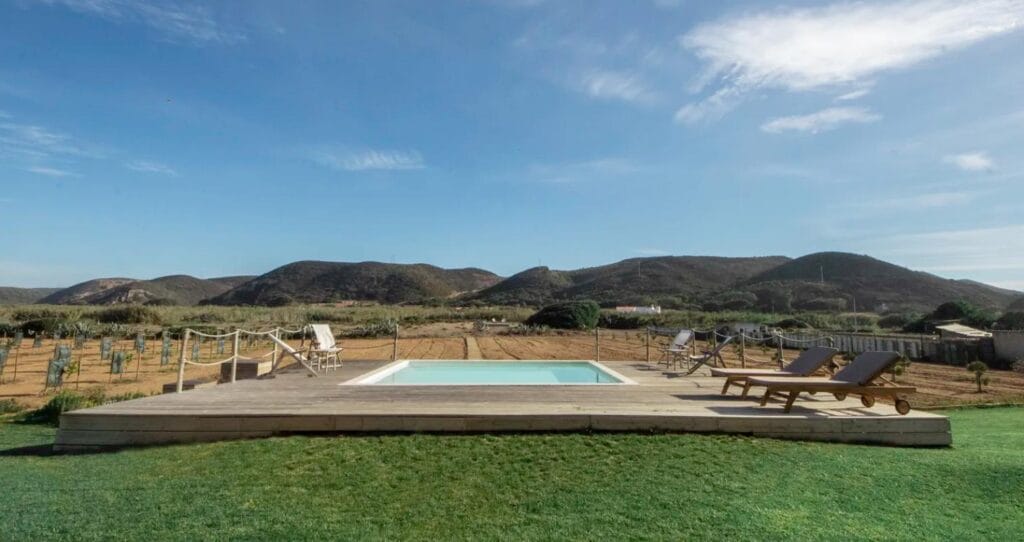
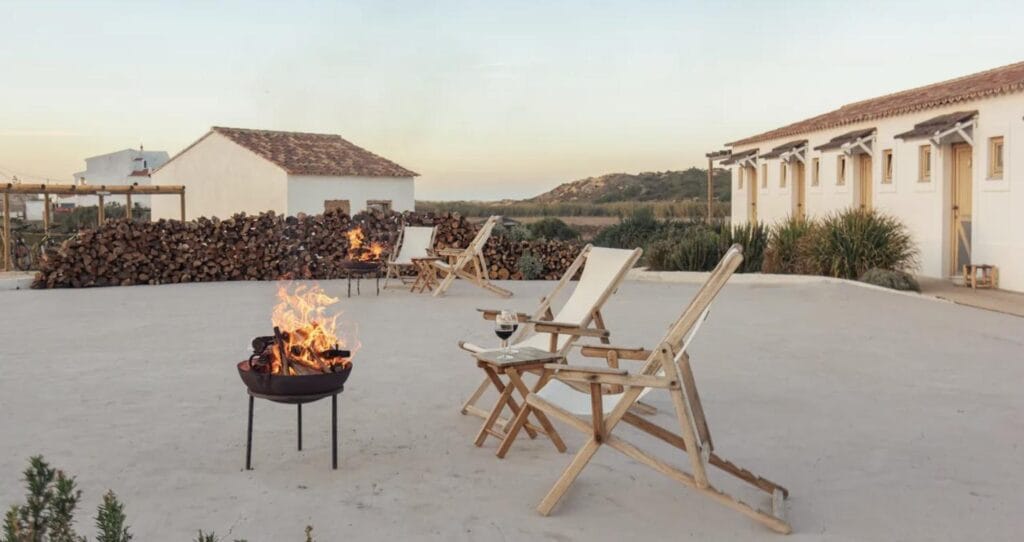
The retreat house is Hortas do Rio, a farmhouse on the Estrada da Praia between the village and the beach, built on what was the family’s vineyard and vegetable gardens. They kept the old thatch-and-tile roofs and added seven double rooms of 22 square meters, each with a private terrace facing the garden. There is a pool, a common room with an honesty bar, and a stretch of riverbank along the Ribeira da Carrapateira. Guests 12 and up.
It holds a 5.0 on TripAdvisor from more than a hundred reviews and is the top-rated place to stay in the village. Seven rooms. We take all of them, which is how the group ended up at seven people.
If you extend the trip
Aljezur’s castle is tenth-century Islamic, taken in 1246, free to walk into. The town market is the third Monday of the month.
Monchique is an hour inland and worth a full day. Fóia at 902 meters is the highest point in the Algarve. There is a spa town at Caldas de Monchique and medronho distilleries you can visit. A weaving tradition survives up there in a water-powered wool mill and among a handful of basket makers, though no permanent studio takes visitors yet.
Sagres is twenty-two minutes south, with the fortress and the cape at São Vicente, the southwestern corner of Europe. Odeceixe, on the Alentejo border, has a Blue Flag beach at a river mouth. Vila Nova de Milfontes is under an hour further up the coast.
For makers specifically: Pot Corner in Aljezur opened in 2025 with Portuguese ceramics, baskets and lamps, all handmade. Paraíso Artesano is a pottery warehouse on the N125 outside Vila do Bispo selling terracotta and linens, cash only. Olaria Pequena in Porches, an hour east, has been a working pottery since 1968 and you will usually find someone painting. And Retrosaria Rosa Pomar in Lisbon, at the other end of the transfer, is the reason to arrive a day early. We wrote about their wool here, and about the rest of Portugal’s craft regions in Portugal for Makers.